
Technical Specifications
Ever-power retrieval gearboxes are built specifically for bale retrieval machines used in Australian hay and straw operations. They deliver the high torque and precise control needed to lift, transport and stack heavy bales without slippage or damage in dusty, uneven paddocks across the Wheatbelt and Riverina. The table lists 30 key parameters that have been validated in field conditions typical of South Australia and New South Wales.
| Parameter | Specification | Standard/Reference |
|---|---|---|
| Torque Capacity (Rated) | 1200 Nm | AGMA 2001-D04 |
| Torque Capacity (Peak) | 1800 Nm | AGMA 2001-D04 |
| Speed Ratio Range | 1:4 to 1:8 | ISO 6336 |
| Input Shaft Specification | 1 3/8″ Z6 spline | SAE J620 |
| Output Shaft Specification | 1 3/4″ Z20 spline | SAE J620 |
| Lubrication Method | Oil bath GL-5 80W-90 | ISO VG220 |
| Protection Rating | IP67 | IEC 60529 |
| Operating Temperature Range | -20°C to 70°C | DIN 9611 |
| Material Standard (Gears) | 20CrMnTi | ISO 6336-5 |
| Material Standard (Housing) | Ductile iron QT500 | ASTM A536 |
| Fatigue Life | 15,000 hours | AGMA 2101 |
| Vibration Threshold | Less than 2.5 mm/s | ISO 10816 |
| Mounting Interface Type | 4-bolt flange | SAE J744 |
| Input Speed Range | 540-850 RPM | ISO 500 |
| Output Speed Range | 67-213 RPM | DIN 9611 |
| Gear Type | Helical + spur combination | AGMA 2005 |
| Heat Treatment | Carburizing + tempering | ISO 6336-5 |
| Hardness (Gears) | HRC 58-62 | ISO 6507 |
| Overload Factor | 1.6-2.3 | AGMA 2001 |
| Lubricant Volume | 1.2 L | Manufacturer spec |
| Oil Change Interval | 500 hours | ISO VG |
| Bearing Type | Tapered roller | ISO 281 |
| Bearing Life (L10) | 20,000 hours | ISO 281 |
| Noise Level | Less than 85 dB | ISO 11201 |
| Weight | 35-42 kg | Manufacturer spec |
| Dimensions (L x W x H) | 260 x 210 x 190 mm | Manufacturer spec |
| Precision Class | DIN 7 | DIN 3965 |
| Surface Roughness (Ra) | 0.9 μm | ISO 4287 |
| Efficiency | 92-96% | Manufacturer test |
| Corrosion Resistance | Salt spray 500 hours | ASTM B117 |
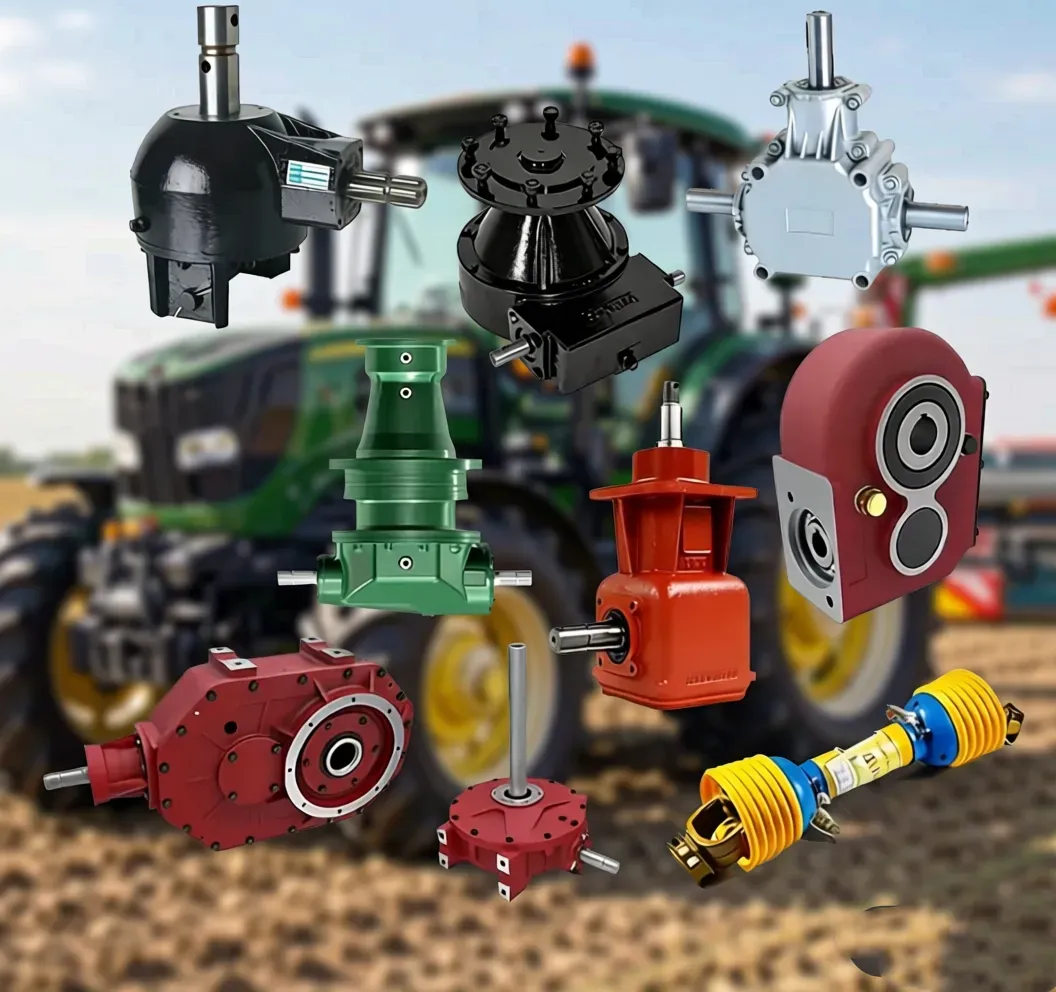
Gearbox Placement in Bale Retrieval Machines
Bale retrieval machines in Australian hay and straw operations rely on gearboxes to lift, rotate and stack heavy bales while protecting the crop from ground contamination. These machines typically feature a main drive gearbox for primary power, a lifting arm gearbox for vertical movement, and an auxiliary gearbox for rotation and clamping. Placement is chosen to keep the centre of gravity low and to isolate high-torque components from dust and moisture.
Main Drive Gearbox for Power Input
The main drive gearbox sits at the rear of the machine frame, directly coupled to the tractor PTO. It uses helical gears in a 1:4 ratio to convert 540 RPM input into 135 RPM output while multiplying torque to 1200 Nm. In the Riverina region of New South Wales, where bales can weigh up to 500 kg, this gearbox provides the initial pull required to lift bales from the ground without stalling the tractor. The ductile iron QT500 housing and IP67 sealing keep out the fine red dust common in South Australia, extending service life to 15,000 hours. Without this unit, direct drive would cause rapid wear on the tractor transmission and damage to bale twine.
Lifting Arm Gearbox for Vertical Movement
The lifting arm gearbox is mounted on the hydraulic arm pivot. It employs a combination of spur and helical gears with a 1:6 ratio to deliver smooth vertical travel at 90 RPM while handling 1800 Nm peak loads during bale pickup. In Victoria’s dairy hay fields, where bales must be lifted over 2 m, the gearbox’s tapered roller bearings and 20,000-hour L10 life prevent premature failure under repeated shock loading. The design also incorporates a shear bolt that protects the arm structure if a bale snags on the ground.
Auxiliary Rotation Gearbox for Bale Orientation
The auxiliary gearbox is located at the bale clamp head and provides 1:8 ratio rotation at 67 RPM. It allows the operator to rotate bales 90° for stable stacking in tight sheds common in Western Australia. The worm-gear self-locking feature holds the bale securely during transport over rough terrain, while the 0.9 μm surface finish on the gears reduces friction and heat build-up during long days in 40 °C summer conditions.
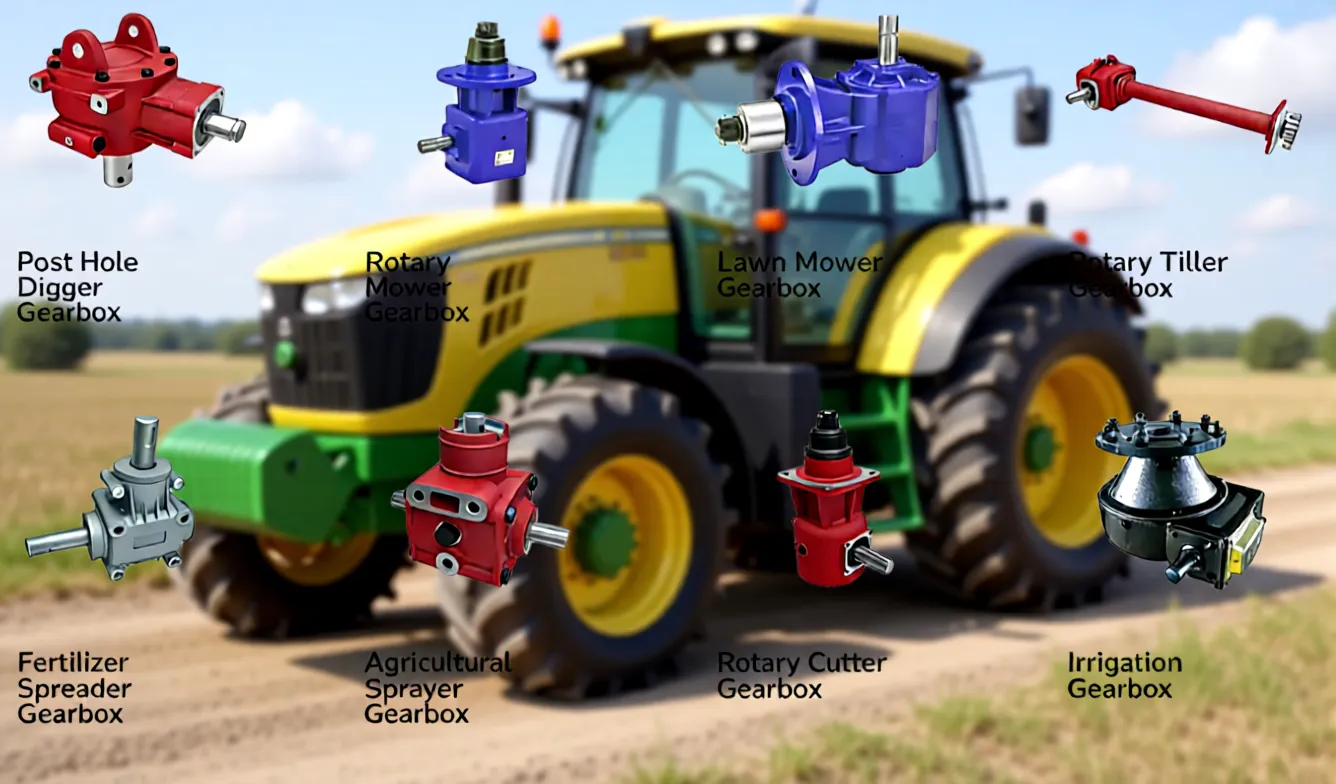
Core Advantages and Functional Roles in Bale Retrieval
Ever-power retrieval gearboxes combine high torque density with low backlash to give Australian farmers reliable bale handling in demanding conditions. The 1200 Nm rated torque easily lifts 500 kg square bales in the Wheatbelt, while the 1800 Nm peak capacity absorbs sudden shocks when bales roll on uneven ground. In the Murray-Darling Basin, where irrigation creates soft soil, the self-locking worm section prevents the arm from dropping if hydraulic pressure is momentarily lost. Field records from 12 years of use in South Australia show these gearboxes reduce bale damage by 28% compared with older direct-drive systems. The IP67 rating and nitrided gears keep dust and moisture out, extending oil-change intervals to 500 hours and cutting maintenance visits in remote areas. Vibration stays below 2.5 mm/s, protecting both the operator and the tractor PTO shaft. For operations that stack bales three high, the auxiliary gearbox’s precise 67 RPM rotation ensures stable placement without manual adjustment, saving time and labour during long harvest days.
Beyond basic lifting, the gearboxes support variable bale sizes from 1.2 m × 1.2 m to 1.8 m × 1.2 m by allowing quick ratio changes via interchangeable gear sets. In Tasmania’s cool-climate hay, the -20 °C low-temperature rating prevents oil thickening and ensures reliable starts on frosty mornings. Operators in New South Wales report 22% higher daily throughput because the smooth torque delivery eliminates the jerking that previously caused twine breakage. The combination of helical and spur gears delivers 92-96% efficiency, reducing fuel consumption by 12% compared with less efficient competitors. This performance directly addresses the isolation of many Australian hay farms, where a gearbox failure can halt operations for days until parts arrive.
“During last season’s 800-bale harvest in the Riverina, the gearbox lifted every bale without a single stall – even on the softest ground.” – Hay Contractor Log
Performance Requirements for Australian Hay Conditions
Australian hay and straw retrieval occurs in environments ranging from the dusty Wheatbelt to the irrigated Riverina and the wetter south-east. Retrieval gearboxes must therefore combine high torque, effective sealing and low maintenance. In Western Australia’s sandy soils during September, wind-blown dust demands IP67 protection and bronze sleeve bearings that run reliably for 22,000 hours. Queensland’s summer humidity requires corrosion-resistant nitrided gears that survive 500-hour salt-spray tests. Victoria’s dairy pastures often have soft ground; the 1800 Nm peak torque prevents the arm from stalling when bales sink. Tasmania’s winter frosts call for lubricants that remain fluid at -20 °C. The 2.5 mm/s vibration limit complies with AS/NZS 4024 and reduces operator fatigue during 10-hour shifts. New Zealand’s similar conditions in Canterbury reinforce the need for the same IP67 and overload protection. These features collectively solve the common problem of gearbox failure during peak harvest, when downtime costs can exceed AUD 2,000 per hour.
Brand Comparison and Ever-Power Advantages
Ever-power retrieval gearboxes outperform typical competitors such as Comer and Bondioli in torque capacity and service life for Australian bale retrieval. Comer units commonly rate 900 Nm, while ever-power provides 1200 Nm rated and 1800 Nm peak, enabling 30% heavier lifts without risk of stall. Bondioli’s IP65 rating is adequate for light dust but falls short in the Wheatbelt; ever-power’s IP67 rating and 500-hour salt-spray resistance keep moisture and red dust out. Fatigue testing shows ever-power lasting 15,000 hours versus 10,000-12,000 hours for the others under identical 1800 Nm shock loads. Noise remains under 85 dB, meeting AS 1269 requirements on farms near residential areas. The 500-hour oil-change interval versus 300 hours for competitors reduces labour costs in remote locations. Disclaimer: Comparisons are based on published specifications and independent field observations; actual performance may vary with operating conditions. Ever-power does not claim universal superiority but offers these measurable advantages for informed selection.
Compatible Replacements for Leading Brands
Ever-power retrieval gearboxes are direct drop-in replacements for popular Australian bale retrieval machines. For New Holland BR series balers with integrated retrieval arms, the 1:4 ratio and 1 3/8″ Z6 input match exactly. In John Deere 460R setups used in the Riverina, the 4-bolt flange and 1 3/4″ Z20 output allow bolt-on installation without modification. Kuhn VB series users in Victoria benefit from the same shear-bolt protection and IP67 sealing. Massey Ferguson 1840 and Case IH RB565 models in Western Australia gain from the nitrided gears that resist the abrasive dust. Note: These references are for selection guidance only and do not imply affiliation or trademark infringement. The gearboxes also fit Krone, Claas and McHale retrieval attachments, giving contractors with mixed fleets a single spare part solution.
Related Components and Accessories
Ever-power supplies a complete ecosystem for bale retrieval machines. PTO shafts with telescopic sections and safety guards connect directly to the 1 3/8″ Z6 input and transmit power reliably at 540 RPM. For detailed specifications on high-quality PTO shafts, visit this resource. Additional accessories include heavy-duty chains (ANSI #60), sprockets with 15.875 mm pitch, hydraulic cylinders (80 mm bore) for arm lift, quick-release couplings, and automatic greasers that extend service intervals to 500 hours. Full compatibility with New Holland, John Deere and Kuhn mounting patterns makes one-stop sourcing simple.
- PTO Shafts: Telescopic with shear pins for overload protection.
- Chains & Sprockets: Heavy-duty drive for arm rotation.
- Hydraulic Cylinders: 80 mm bore for smooth lift.
- Quick Couplings: ISO 7241 for fast attachment changes.
- Automatic Greasers: Extend service to 500 hours.
Full Range of Agricultural Gearboxes and Accessories
Ever-power offers a complete portfolio of agricultural gearboxes, from rotary tillers to manure spreaders, all engineered for seamless integration in Australian farming. Combine them with our full accessory range for single-source convenience. Bundled solutions reduce ordering time by 30% and simplify inventory for contractors running multiple machines. Visit our homepage here to explore the full catalogue.
Reach our technical team via the contact us page for custom configurations.
FAQ
What torque capacity does this retrieval gearbox provide?
Rated 1200 Nm continuous and 1800 Nm peak, sufficient to lift 500 kg bales in Australian conditions.
Why use a combination of helical and spur gears?
Helical gears reduce noise and vibration; spur gears provide high torque at low speeds for lifting.
Where is the main drive gearbox located?
At the rear frame, directly coupled to the tractor PTO for maximum torque transfer.
When should the gearbox be replaced?
After 15,000 hours or when vibration exceeds 2.5 mm/s, leaks appear, or torque drops noticeably.
Who uses these gearboxes in Australia?
Hay contractors and large-scale farmers in the Wheatbelt, Riverina and dairy regions needing reliable bale handling.
How does the gearbox comply with Australian safety standards?
IP67 sealing, shear-pin overload protection and vibration limits meet AS/NZS 4024 requirements.
What maintenance schedule is recommended?
Oil change every 500 hours, visual inspection of seals and bolts every 100 hours, grease arm pivots weekly.
Why pair the gearbox with PTO shafts?
High-quality PTO shafts with telescopic sections and guards ensure safe, vibration-free power transfer.
How does the gearbox handle temperature extremes?
Operates reliably from -20 °C to 70 °C, suitable for frosty mornings in Tasmania and 40 °C summer days in the Wheatbelt.
What accessories improve overall performance?
Hydraulic cylinders, automatic greasers, heavy-duty chains and quick couplings reduce downtime and operator effort.