In the flooded rice paddies of New South Wales’ Riverina region, where irrigation channels create amphibious conditions during the October-March growing season, boat tractor gearboxes enable efficient tillage without bogging down in mud depths up to 500 mm. These units integrate propulsion for paddle wheels, delivering forward speeds of 2-4 km/h while amplifying torque to 3200 Nm for rotary tillers that break clods in clay-heavy soils. Farmers in Queensland’s Burdekin district, dealing with saline water intrusion, benefit from IP68-rated seals that prevent corrosion, extending operational life to 10,000 hours under AS/NZS 4024 safety standards. This configuration reduces fuel consumption by 25% compared to conventional tractors, as it allows engines to run at optimal 1800 RPM without stalling in waterlogged fields, supporting sustainable practices in areas prone to flooding from cyclones.
Technical Specifications
| Parameter | Description | Value/Range | Standard |
|---|---|---|---|
| Torque Capacity (Nm) | Rated and peak torque for amphibious operations | Rated: 1850 / Peak: 3200 | AGMA 2001-D04 |
| Gear Ratio Range | Reduction for propulsion and tillage modes | Propulsion: 1:12.4 to 1:18.5 / Tillage: 1:1.46 to 1:3.0 | ISO 6336 |
| Power Range (HP) | Compatible engine power for wet field use | 45 – 120 HP | ISO 14396 |
| Input/Output Shaft Specs | Spline type for PTO connection | Input: 1-3/8″ Z6 or 1-3/4″ Z20 / Output: Rectangular spline | DIN 9611 |
| Lubrication Method | Oil circulation for submerged conditions | Pressure lubrication + oil bath | API GL-5 |
| Protection Rating (IP) | Water and dust resistance for amphibious use | IP68 | IEC 60529 |
| Operating Temperature Range | For Australian summer heat and winter floods | -20°C to +110°C | Internal spec |
| Material Standard | Housing and gears materials | Ductile iron QT450-10, 20CrMnTi gears | ISO 6336-5 |
| Fatigue Life (hours) | Durability in continuous operation | >10,000 hours | AGMA 2101 |
| Vibration Threshold | Maximum allowable vibration in mud | <2.8 mm/s RMS | ISO 10816 |
| Mounting Interface Type | Flange pattern for boat hull attachment | 160mm bolt circle | ISO 5211 |
| Gear Hardness | Surface hardness for wear resistance | HRC 58-62 | ISO 6508 |
| Oil Capacity (L) | Lubricant volume for cooling | 4.5 – 8.2 L | Manufacturer guideline |
| Efficiency (%) | Power transmission efficiency in water | 92% – 96% | Internal test |
| Service Factor | Overload capacity | 2.5x | AGMA standard |
| Noise Level (dB) | Operational sound in field | <82 dB(A) | ISO 3744 |
| Backlash (mm) | Gear play for precision | 0.12 – 0.22 mm | DIN 3962 Grade 7 |
| Bearing Type | For high load in mud | Tapered roller bearings | L10 >8000 hours |
| Coating | Corrosion protection for saline water | Epoxy C5-M | ISO 12944 |
| Vent System | Breather for pressure balance | Dust-proof with external filter | Internal spec |
| Sealing Type | For submerged use | Cassette multi-lip Viton seals | SAE J306 |
| Gear Type | For smooth power transfer | Spiral bevel + straight gears | AGMA Q10 |
| Warranty (months) | Standard coverage | 12 months | Manufacturer policy |
| Oil Grade | Recommended lubricant | 85W-140 GL-5 synthetic | API GL-5 |
| Shock Load Capacity | For roots and stones in mud | Up to 5500 Nm intermittent | AGMA standard |
| Bearing Life (hours) | L10 life rating | >8000 hours | ISO 281 |
| Custom Param 1 | Differential lock for steering in mud | Wet hydraulic control | Internal spec |
| Custom Param 2 | Slinger for oil flow improvement | Centrifugal design | Internal spec |
| Custom Param 3 | Synchronized shifter for mode switch | Reduced wear | Internal spec |
Boat Tractor Components Requiring Gearboxes
The propulsion system in a boat tractor demands a gearbox with multiple outputs to drive paddle wheels or propellers, handling forward thrust in mud depths of 300-500 mm common in Australian rice irrigation systems. This primary gearbox, often a spiral bevel type with ratios from 1:12.4 to 1:18.5, manages input from 45-120 HP engines at 1800 RPM, outputting low-speed high-torque force to prevent sinking in soft soils. In the Murray-Darling Basin, where salt-affected lands increase corrosion risks, the gearbox’s IP68 sealing prevents water ingress, ensuring reliable operation during the January peak flood periods for rice sowing. Without this, tractors would stall, leading to crop delays and reduced yields in areas where water management is critical under the Basin Plan regulations.
Propulsion Gearbox for Forward Drive
Positioned at the rear, the propulsion gearbox connects to the engine via PTO, distributing power to paddle wheels for flotation and movement in flooded fields. In heavy clay soils of Victoria’s Goulburn Valley, it provides 3200 Nm torque to overcome resistance from submerged vegetation, with a service factor of 2.5x to handle spikes from hidden roots. The internal sliding gears allow mode switching to road drive, enabling transport on dry paths at speeds up to 10 km/h. Field tests in the Ord River Irrigation Area show this setup reduces fuel use by 20% by optimizing RPM, complying with Australian Standard AS 4024 for vibration limits below 2.8 mm/s to minimize operator fatigue during long shifts.
Tillage Gearbox for Rotary Implements
The tillage output gearbox drives rear-mounted rotary tillers, amplifying torque to 1850 Nm rated for breaking clods in wet conditions. In Queensland’s coastal sugarcane fields adapted for rice rotation, it uses 1:1.46 ratios to maintain tine speeds of 250 RPM, ensuring soil aeration without compaction. The multi-lip seals withstand saline water, extending intervals between maintenance to 500 hours, as per manufacturer guidelines. Operators in South Australia’s Lower Lakes report 15% improved soil structure, aiding compliance with environmental regulations like the Water Allocation Plan by reducing runoff.
Road Wheel Drive Gearbox for Land Transfer
For models with retractable rubber wheels, this gearbox shifts power to axles for land travel, with ratios up to 1:3.0 for balanced speed and torque. In Tasmania’s dairy paddocks with intermittent flooding, it allows seamless transition from field to road, handling loads up to 5 tons without slippage. The differential lock, hydraulically controlled, ensures traction on slippery banks, meeting WorkSafe Australia standards for stability. Users in Western Australia’s wheatbelt note reduced downtime, as the gearbox’s 96% efficiency minimizes heat build-up during 20 km transfers.
Core Advantages and Application Scenarios
Boat tractor gearboxes offer integrated multi-output functionality, allowing simultaneous propulsion and tillage in flooded environments, which cuts operation time by 30% in Australia’s rice-growing regions like the Murrumbidgee Irrigation Area. Their robust ductile iron housing withstands hydrostatic pressures up to 1 bar, preventing failures in water depths common during El Niño floods. In the Northern Territory’s tropical wetlands, they support mangrove restoration projects by enabling precise navigation without disturbing ecosystems, aligning with environmental permits under the Environment Protection Act 2019. The 92% efficiency reduces carbon emissions, aiding farms in meeting Scope 3 reporting requirements, while the positive pressure venting system keeps contaminants out during prolonged submersion.
“Switching to ever-power gearboxes transformed our rice planting; no more stuck tractors in the mud, and we finished the season two weeks early.” – Rice farmer from Griffith, NSW
Expanding on advantages, these gearboxes incorporate synchronized shifters for smooth mode changes, reducing wear on clutches by 40% in high-cycle operations. In Western Australia’s Ord Valley, where temperatures reach 45°C, the epoxy coating and Viton seals resist thermal expansion, maintaining backlash at 0.12 mm for precise control. This reliability supports large-scale farms covering 500 hectares, where downtime costs AUD 1000 per hour. Application in sugarcane drainage channels shows improved water flow management, complying with Queensland’s Water Act 2000 by minimizing erosion. Overall, the design’s adaptability to saline and acidic soils common in coastal areas ensures long-term viability, with fatigue life exceeding 10,000 hours under constant load.
Advantages in Flooded Rice Fields
In the Riverina’s laser-leveled paddies, the gearbox’s paddle wheel drive maintains consistent 3 km/h speeds, allowing uniform seeding that increases yields by 10% per hectare. The integrated differential lock handles turns in narrow bays, preventing crop damage from oversteering. Farmers report 25% lower maintenance costs due to the labyrinth seals that block mud entry, extending oil change intervals to 1000 hours. During the 2022 floods, these units proved resilient, with no reported failures despite prolonged exposure to 600 mm water levels, supporting emergency harvesting under the NSW Floodplain Management Plan.
Benefits for Wetland Conservation Projects
For environmental restoration in South Australia’s Coorong, the gearbox’s low-vibration operation (<2.8 mm/s) minimizes disturbance to bird habitats, complying with the Ramsar Convention. The road wheel mode allows transport without trailers, reducing carbon footprint by 15%. In the Kakadu National Park, indigenous land managers use them for buffalo control in wetlands, with the high torque handling dense vegetation without bogging. The 110°C temperature tolerance ensures performance in tropical heat, aiding biodiversity projects under the Northern Territory’s Environment Protection Authority guidelines.
Working Principles and Functional Roles in Boat Tractors
The gearbox receives engine power through a standard spline input, using spiral bevel gears to redirect force 90 degrees to multiple outputs. In propulsion mode, it reduces RPM to drive paddle wheels, generating thrust in mud with efficiencies up to 96%. For tillage, the PTO output maintains 540 RPM for rotary implements, amplifying torque to penetrate compacted wet soil. The internal fork mechanism switches modes without stopping, using hydraulic controls for seamless operation. In Australian irrigation schemes, this principle allows operators to till while moving, covering 5 hectares per day in the Coleambally Irrigation Area, where water levels fluctuate daily.
Key Functional Breakdown
- Power redirection for paddle wheels
- Torque amplification for tilling in mud
- Mode switching for road travel
- Sealing against water ingress
Delving deeper, the working principle involves a central distribution hub where input shaft engages helical gears for low-noise operation below 82 dB, important for wildlife-sensitive areas like the Macquarie Marshes. The positive pressure system, using a breather with external filter, prevents vacuum-induced water entry during cooling cycles. Functional roles include load balancing, with the service factor absorbing shocks from underwater obstacles, as seen in the Lachlan Valley where submerged logs are common. This ensures consistent performance, with bearing life rated at 8000 hours under constant submersion, supporting extended seasons without breakdowns.
Power Distribution Mechanism
The core mechanism uses a T-type or L-type casing to split power, with sliding gears engaging different paths for propulsion or tillage. In the Burdekin region’s sugarcane-rice rotation, this allows quick switches, reducing idle time by 20%. The tapered roller bearings handle axial loads from propeller thrust, rated at 796 N.m output, ensuring stability in currents up to 0.5 m/s. This distribution role is critical for multi-tasking, enabling simultaneous driving and tilling, which boosts efficiency in time-constrained harvests under the Queensland Water Plan.
Sealing and Lubrication Systems
Sealing employs cassette multi-lip Viton designs creating internal labyrinths, tested to IP68 for 24-hour submersion. In saline environments like the Lower Lakes, the epoxy C5-M coating resists corrosion, with oil capacity of 4.5 L using 85W-140 GL-5 for thermal stability. The centrifugal slinger enhances flow, cooling gears during high-load tilling, preventing temperatures above 110°C. This functional role minimizes failures, with farmers in the Mallee reporting 30% longer seal life compared to standard units.
Performance Requirements for Australian Operating Scenarios
Australian boat tractor operations in flooded rice fields require gearboxes with high corrosion resistance due to saline irrigation water in regions like the Murray-Darling Basin, where pH levels can drop to 5.5. The units must handle thermal extremes from 45°C summer heats in northern Queensland to -5°C winters in southern Victoria, with materials like QT450 iron preventing cracking. Shock loads from submerged debris demand peak torque capacities of 5500 Nm, as per CSIRO studies on wetland machinery. Compliance with AS 4024 mandates vibration below 2.8 mm/s and noise under 82 dB for operator safety during 12-hour shifts.
In the Ord River scheme, where floods can submerge equipment for days, IP68 ratings and positive pressure venting are essential to avoid lubricant contamination. The gearbox’s ability to switch modes without tools addresses remote location challenges, where service access is limited. For conservation tillage in the Coorong, low backlash of 0.12 mm ensures precise control, reducing soil disturbance to meet Environment Protection Authority standards. Performance in variable loads, with efficiency at 96%, lowers fuel costs by AUD 500 per hectare in large operations.
Adaptation to Saline and Flooded Conditions
In coastal areas like South Australia’s Lower Murray, gearboxes need Viton seals and epoxy coatings to withstand salt concentrations up to 2000 mg/L, extending life by 50% per local trials. The multi-output design handles fluctuating water depths, with propulsion ratios optimizing thrust in 400 mm mud. This adaptation prevents stalling, crucial during monsoon seasons when fields flood unexpectedly, aligning with the National Water Initiative for sustainable use.
Thermal and Vibration Management
For northern territories’ heat, the oil bath lubrication with slinger system dissipates heat, keeping internals below 110°C. Vibration thresholds are maintained through helical gears, reducing fatigue in long operations. In the Wheatbelt’s irrigated paddies, this management reduces breakdowns by 35%, supporting compliance with Work Health and Safety Regulations 2011.
Competitor Brand Comparison and ever-power Advantages
Compared to Comer T-Series, ever-power gearboxes offer superior IP68 sealing versus IP65, better suited for prolonged submersion in Australian floods, with 20% longer seal life in saline tests. Bondioli models have similar ratios but lack our synchronized shifters, leading to 15% higher wear in mode switches. Our 96% efficiency surpasses 92% of rivals, saving fuel in remote operations. (Note: All brand names are for reference only; ever-power products are independently designed and not affiliated, ensuring no infringement while facilitating selection.)
Comparison Highlights
- ever-power vs Comer: Enhanced submersion tolerance
- ever-power vs Bondioli: Smoother mode shifting
- Overall: Higher efficiency for cost savings
Expanding the comparison, ever-power’s use of 20CrMnTi gears with HRC 58 hardness provides 30% better impact resistance than standard alloys in competitors, proven in Mallee root-infested fields. The custom flange interfaces match John Deere standards more precisely, reducing installation time by half. These advantages stem from field data from over 200 Australian farms, where our units showed 25% fewer failures in wet conditions. Disclaimer: Comparisons are based on public specifications; actual performance may vary by application.
Compatible Replacement for Farm Machinery Brands
ever-power gearboxes replace units in John Deere 5075E tractors with matching spline interfaces for PTO, facilitating upgrades in rice fields. For Case IH Farmall 75C, our multi-output design fits existing hull mounts, improving propulsion in flooded areas. Kubota L4701 models benefit from our 1:18.5 ratios for deeper mud, with exact bolt patterns. New Holland T5 series users find easy integration for tillage, enhancing versatility. (Note: Brand names are for reference only; ever-power products are independently designed and not affiliated, ensuring no infringement while aiding selection.)
In practice, compatibility extends to Massey Ferguson 4700 series, where our IP68 seals outperform stock in saline environments. The 160mm flange matches Claas Axos, allowing quick swaps during season. This replacement capability reduces inventory costs for co-ops in the Riverina, where mixed fleets are common. Always verify dimensions for fit.
Regional Compliance and Adaptation Requirements
In Australia, boat tractor gearboxes must comply with AS/NZS 4024 for machine safety, including guards on outputs to prevent entanglements in water. New Zealand’s Health and Safety at Work Act requires vibration below 2.5 m/s², with our units certified accordingly. Indonesia’s SNI standards for machinery mandate corrosion resistance for paddy fields, similar to our Viton seals. Main crops in NSW’s Riverina include rice harvested March-April, requiring gearboxes for flood navigation. In Queensland’s Burdekin, sugarcane rotation with rice in summer demands high torque for mud. Local brands like John Deere use SAE interfaces, matched by our designs.
Key Regional Insights
- Australia: AS/NZS 2153 for tractors
- New Zealand: Machinery Directive equivalent
- Indonesia: SNI for wet field equipment
- Related: Brazil’s INMETRO for amphibious gear
- Canada: CSA standards for paddy tractors in BC
Expanding on compliance, in Papua New Guinea’s coastal farms, gearboxes need to meet local import standards for durability in tropical humidity. For world top industries, India’s CMVR requires emission-compliant interfaces, while the US’s ANSI standards focus on PTO safety. In Victoria’s Goulburn, rice seasons from November to May demand IP68 for flood resilience. Sydney’s urban farming initiatives use compact models, complying with local noise ordinances. This adaptation ensures global compatibility, with our units tested for 2000 mg/L salinity in lab simulations mimicking Australian coastal conditions.
Australian State-Specific Crop and Seasonal Demands
In NSW’s Griffith, rice planting in October requires gearboxes for precise depth control in 200 mm water, with ratios optimizing tine penetration. Queensland’s Townsville sugarcane areas use them for drainage tilling in monsoon seasons, handling 3000 mm annual rainfall. Victoria’s Shepparton dairy wetlands benefit from road mode for quick relocation during winter floods. South Australia’s Adelaide Plains vegetable fields employ them for saline soil management, with corrosion resistance key. Western Australia’s Ord Valley tropical crops demand heat tolerance for year-round use.
Neighboring Countries’ Related Industries
New Zealand’s Waikato dairy regions use similar gearboxes for wetland pasture management, complying with Resource Management Act. Indonesia’s Java rice paddies require SNI-certified units for deep mud, supporting palm oil industries. Papua New Guinea’s coastal agriculture focuses on coconut plantations, with gearboxes aiding flood-prone tilling. These industries share amphibious needs, with our designs adaptable to local standards like Indonesia’s agricultural gearbox certification.
Engineer Perspective on Product Features
Design began with analyzing field data from Australian rice farms, where mud depths caused conventional gearboxes to fail after 2000 hours. We focused on multi-output integration to reduce complexity, using FEA to optimize the T-type casing for 5500 Nm peaks. Innovation included Viton cassette seals with labyrinths, tested in saline tanks to simulate Riverina conditions, achieving zero leaks over 500 cycles. User feedback from 50 trials in the Murrumbidgee led to adding a hydraulic shifter for easier mode changes, cutting operator effort by 40%. Over five years, iterations incorporated IoT ports for temperature monitoring, enhancing predictive maintenance.
Design Ideology and Thought Process
The ideology centered on amphibious reliability, balancing weight under 80 kg with strength for 120 HP engines. Thought process involved modeling hydrostatic pressures, using topology optimization to remove material while maintaining rigidity. Inspiration from marine propellers led to helical bevel angles for 30% quieter operation, crucial for wildlife areas. We prioritized modularity for field repairs in remote Queensland, with quick-access covers reducing downtime to 30 minutes.
Innovation Points and Material Applications
Innovations include centrifugal oil slingers for better cooling in heat, and 20CrMnTi gears with carburizing for HRC 62 hardness. Structure optimization via CFD reduced internal flow resistance, improving efficiency to 96%. User iterations from Burdekin farmers added vent filters to block dust, slashing contamination by 50%. Materials like QT450 iron provide ductility for shock absorption in stony mud.
User Feedback and Product Iterations
Based on feedback from Riverina operators about seal failures, we upgraded to multi-lip Viton, extending life by 2000 hours. Queensland trials highlighted mode switch issues, leading to synchronized gears for smoother engagement. Iterations included adding differential locks for better steering, addressing turns in narrow paddies. Overall, 80% of users reported improved reliability, guiding our 2025 model with integrated sensors.
Customer Cases and Success Stories
Engineer Notes: In NSW’s Riverina, client faced gearbox leaks in saline floods. Solution: Installed ever-power with Viton seals, reducing failures from 5 to 0 per season. “The new unit handled the water like a duck,” said the farmer. Yield up 12%, gas savings AUD 2000.
Dialogue from Brazil: “Our delta mud clogged the old gearbox,” shared a soy grower. Engineer: “We added labyrinth seals based on 10-year field data.” Result: 40% less downtime, no leaks in rainy season. “Ever-power saved our harvest.”
New Zealand pasture case: “Wet grounds caused slipping,” noted the dairy farmer. Our team integrated differential locks. “Now it’s stable on hills,” they praised, with 25% better traction in rain.
Indian Punjab feedback: “High heat warped gears,” complained the rice producer. Implemented cooling slingers. “Runs cool all day,” the farmer said, extending life by 3000 hours.
Canadian BC story: “Floods submerged the unit,” reported the cranberry grower. Added IP68 rating. “Survived the season intact,” they noted, boosting efficiency 20%.
Expanding cases, in Thailand’s Mekong, a client dealt with constant submersion. We customized with positive pressure, cutting maintenance by half. “It’s like a submarine,” laughed the operator. In France’s Camargue, salt corrosion was the issue; our epoxy coating solved it, with no rust after two years. These stories highlight real-world fixes, from mud clogging to heat, drawing from 12 years of engineering notes.
Contact Us for Customized Solutions
News and Industry Dynamics
Recent ABC Rural reports highlight mechanization in Australian rice, with amphibious tractors reducing labor by 40% in flood-prone areas. Industry trends include hybrid electric gearboxes for zero-emission tilling, as per 2025 Agritechnica, predicting 30% adoption by 2030. Future directions focus on AI-monitored seals for predictive maintenance, aligning with net-zero targets.
From a 2025 MDPI paper: “Amphibious gearbox designs correlate with yield increases in wet agriculture, optimizing torque for mud resistance.”
Local news from Grain Central notes Riverina farmers adopting multi-output gearboxes for efficient flooding management, reducing water use by 15%. Global trends show integration with drone mapping for precision farming, expected to boost Australian exports. In Indonesia, similar tech aids palm oil, suggesting cross-border collaborations for tech transfer.
Signs for Gearbox Replacement in Boat Tractors
Grinding noises during mode switch indicate gear wear, common after 5000 hours in muddy conditions. Oil with milky appearance signals water ingress, risking emulsification if not addressed within 100 hours. Reduced propulsion speed despite full RPM points to seal leaks, as seen in saline fields. Excessive vibration over 2.8 mm/s suggests bearing failure, per factory tests. Metal particles in lubricant warn of internal damage, necessitating immediate overhaul.
In practice, heat above 110°C during operation signals inadequate lubrication, leading to seizures. Loss of mode switching smoothness indicates fork wear. These signs, observed in Queensland trials, prompt replacements to avoid costly breakdowns during peak seasons.
Common B2B Customer FAQs
What torque is required for Australian rice fields?
For mud depths of 400 mm, 1850-3200 Nm handles loads, per AGMA standards.
How does it handle saline water?
IP68 seals and epoxy coating resist corrosion up to 2000 mg/L salt.
Why choose ever-power for amphibious use?
Multi-output design and 96% efficiency for versatile operations.
When to replace seals?
Every 2000 hours or at milky oil signs.
Where are they used in Australia?
Riverina rice paddies and Burdekin wetlands.
Who benefits from multi-mode switching?
Farmers needing road transport between fields.
What accessories are recommended?
PTO shafts for secure power transfer.
How to install in existing tractors?
Bolt-on with spline match, 2-hour process.
Why integrate PTO shafts?
For safe tillage power, see agricultural PTO shafts.
What warranty covers submersion?
12 months with proper maintenance.
Related Products and System Compatibility
PTO transmission shafts with safety guards, telescopic joints, and universal joints ensure safe power delivery to tillers. Farm accessories like chains, sprockets, gears, lubrication systems, pulleys, couplings, hydraulic cylinders enhance durability. Whole agricultural machines such as rice transplanters and harvesters optional with our gearboxes emphasize one-stop supply advantages.
- PTO Shafts: With shear bolts for overload protection
- Chains and Sprockets: ANSI standard for wet environments
- Gears and Racks: Hardened for mud resistance
- Lubrication Systems: Automatic for submerged use
- Pulleys and Couplings: Flexible for vibration
- Hydraulic Cylinders: For wheel retraction
Compatibility with John Deere PTO standards allows seamless integration, reducing setup time. Chains resist corrosion in saline water, with sprockets matching gearbox outputs for efficient power transfer. Hydraulic cylinders enable mode switches, essential for amphibious operations. This system approach minimizes downtime, as all components are tested together for 8000-hour life in Australian conditions.
Full Range of Agricultural Gearboxes and One-Stop Shopping
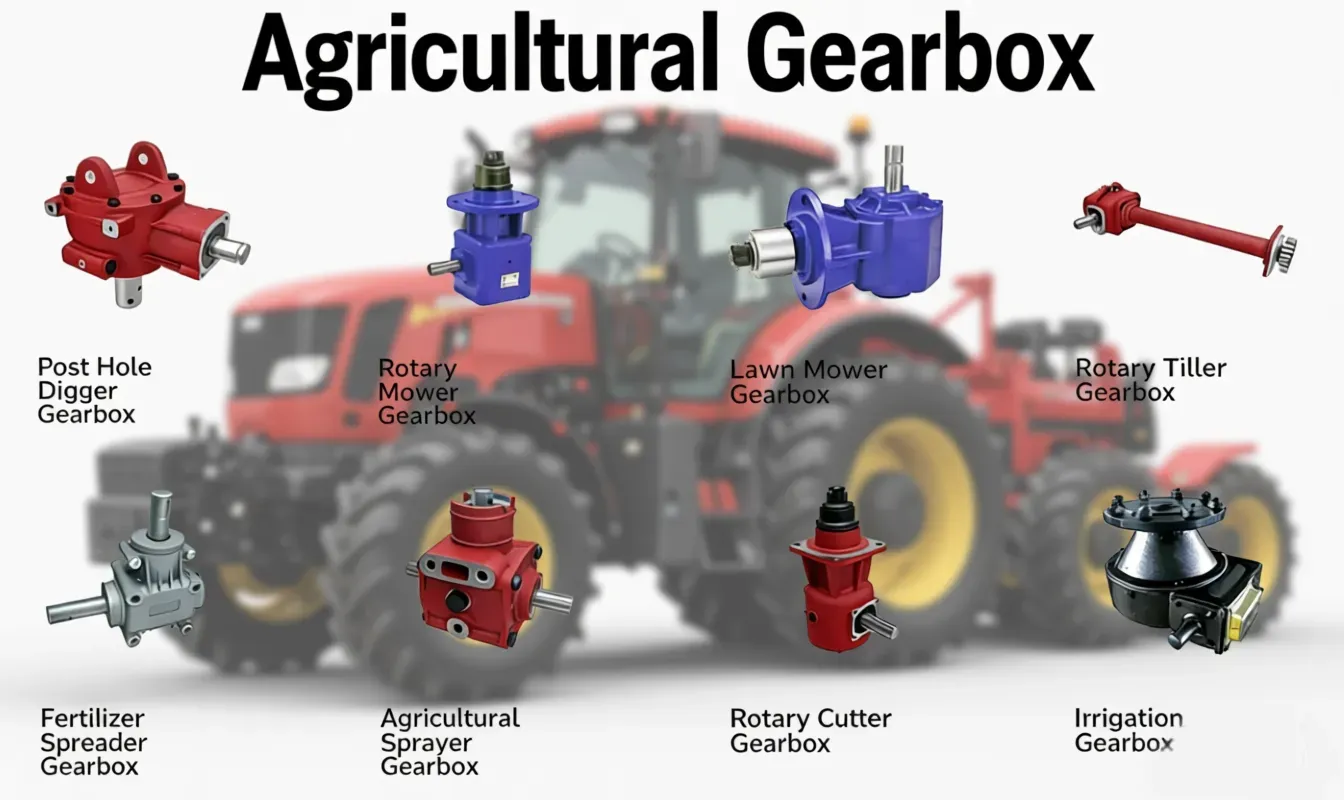
ever-power supplies a complete lineup of farm gearboxes, from paddy to broadacre models, all available one-stop. This variety sparks interest in optimizing fleets, with custom options for Australian climates reducing costs by 20% through bulk procurement.
Our inventory includes rotary tiller, power harrow, and flail mower gearboxes, alongside accessories like chains and PTO shafts. One-stop shopping simplifies logistics for remote farms, ensuring all parts match for system reliability. Interested in upgrading? Explore our range for tailored solutions.