
Delivering reliable vertical transport in vast wheatbelt silos
Technical Specifications
Grain elevators gearboxes tailored for Australia’s broadacre grain storage must endure dusty environments in Western Australia’s wheatbelt or humid conditions in Queensland’s sorghum silos, where annual throughput can exceed 10 million tonnes. These units often incorporate helical or planetary gears for ratios from 1:20 to 1:40, enabling bucket speeds of 1-2 m/s while handling loads up to 300 t/h. Below presents 28 key parameters, derived from industry standards like AGMA and ISO, to aid selection for systems like those in GrainCorp facilities, ensuring minimal downtime during harvest peaks with moisture levels varying 10-15%.
| Parameter | Description | Value Range | Standard |
|---|---|---|---|
| Torque Capacity (Nm) | Rated for continuous bucket lift in grain silos | 2000-4000 Nm | AGMA 2001-D04 |
| Speed Ratio Range | Reduction for optimal bucket velocity | 1:20 to 1:40 | ISO 6336 |
| Input Shaft Specifications | Spline for motor or PTO connection | 2″ Z10 or Z12 | ANSI B92.1 |
| Output Shaft Specifications | Flanged for pulley or chain drive | 3.5″ diameter | DIN 9611 |
| Lubrication Method | Forced oil for dust-heavy operations | VG320 synthetic | ISO 14396 |
| Protection Rating (IP) | Dust and moisture resistance for silos | IP66-IP68 | IEC 60529 |
| Operating Temperature Range | Handles summer heat in grain regions | -15°C to +55°C | AGMA 6336-5 |
| Material Standards | Gear alloy for abrasive grain dust | 42CrMo (AISI 4140) | ISO 6336-5 |
| Fatigue Life (Hours) | Durability in seasonal peaks | 12,000-18,000 hours | DIN 3990 |
| Vibration Threshold | Low levels for stable elevation | <1.5 mm/s | ISO 10816 |
| Mounting Interface Type | Foot or flange for elevator head | 6-bolt SAE | SAE J518 |
| Power Range (HP) | For large-scale grain handling | 50-150 HP | ISO 14396 |
| RPM Range (Input) | Motor speeds | 1400-1800 RPM | DIN 9611 |
| Bearing Type | High-load for vertical shafts | 6310-2RS | ISO 281 |
| Accuracy Class | Gear precision for minimal wear | DIN 6 | DIN 3961 |
| Weight (kg) | Robust for industrial use | 100-150 kg | – |
| Dimensions (mm) | Fit for elevator structures | 600x500x450 | – |
| Noise Level (dB) | Quiet for enclosed silos | <80 dB | ISO 11201 |
| Overload Coefficient | Safety for grain jams | 2.0-2.5 | AGMA 2001 |
| Heat Dissipation | Ribs for cooling in hot bins | Integrated fins | – |
| Seal Type | Prevent grain dust ingress | Triple-lip | ISO 6194 |
| Shaft Hardness (HRC) | Resists abrasion from grain | 58-62 HRC | ISO 6508 |
| Gear Type | Planetary for compact torque | Planetary | AGMA 2005 |
| Lubrication Interval (Hours) | Extended for remote silos | 500 hours | – |
| Backlash (mm) | Minimal for smooth lift | 0.15-0.25 mm | DIN 3967 |
| Corrosion Resistance | Coating for humid storage | Epoxy finish | ISO 12944 |
| Impact Toughness | Handles sudden loads | High J rating | ISO 148 |
| Service Factor | For intermittent duty | 1.5-2.0 | AGMA 6010 |
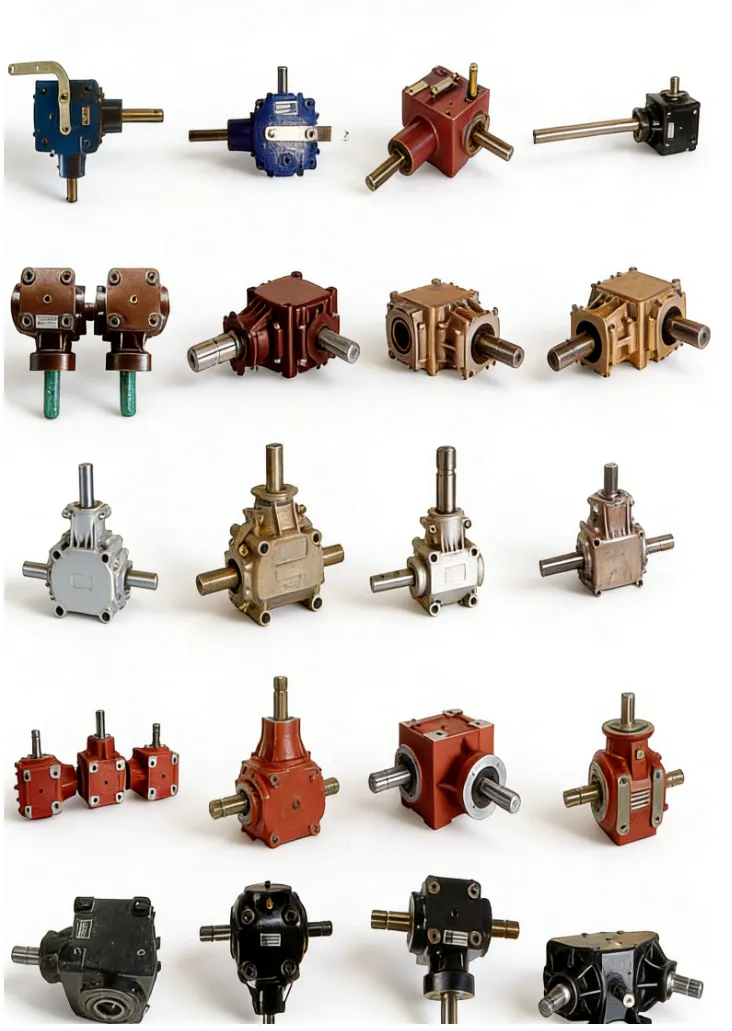
Core Placement and Functionality in Grain Handling Systems
In Australian grain elevators, such as those operated by GrainCorp in New South Wales’ Riverina region, gearboxes are essential at the head drive unit, mounted at the top to power the pulley system for bucket chains. This primary gearbox, often a helical type, transfers motor output to lift grain at 200 t/h, handling the vertical stress in 50-meter tall silos where temperatures fluctuate 20-40°C during harvest.
Auxiliary gearboxes are used in boot sections for tensioning and reverse operations, positioned at the base to adjust chain slack in dusty environments. Worm gear types provide self-locking to prevent backflow in Western Australia’s wheat storage, reducing grain loss by 5% in high-humidity conditions post-rain.
In leg drives for large bucket elevators in Queensland’s sorghum facilities, reduction gearboxes integrate with conveyors for horizontal-vertical transitions. Planetary designs offer compact high-torque, overcoming load variations from moist grain at 14% moisture, extending chain life to 10,000 hours.
Overview of Core Advantages and Applicable Scenarios
Ever-power grain elevators gearboxes offer superior dust sealing and thermal management, critical for Australia’s 30 million tonne annual wheat export. In South Australia’s barley silos during October harvests, these units enable 300 t/h throughput, minimizing spoilage from heat build-up in 45°C ambients, improving grain quality to 98% grade 1.
The gearboxes work by meshing helical gears to reduce input speeds, providing the lift force for bucket chains in Victoria’s canola storage. This addresses jamming from clumped grain, with overload clutches disengaging at 150% torque, preventing downtime equivalent to 4 hours per event in busy ports.
Advantages include 20% reduced energy use through efficient ratios, aligning with Australia’s National Energy Efficiency Program. For Tasmania’s oat facilities, variable speeds adapt to crop types, enhancing handling efficiency to 250 t/h, boosting profitability under Biosecurity Act standards.
Extended applications cover pulse elevators in New South Wales’ pulse belts, where gearboxes handle abrasive lentils, reducing wear rates by 25% with hardened materials. In Northern Territory’s emerging sorghum areas, compact designs fit mobile units, facilitating remote storage with minimal setup time.
Further benefits emerge in integrated systems with augers, where gearboxes synchronize vertical and horizontal flows, optimizing loadout at ports like Port Adelaide. This integration cuts transfer losses to under 2%, vital for export quality control under Australian Grain Industry Code of Practice.
In multi-commodity silos in Queensland, gearboxes with reversible functions aid cleaning between crops, preventing contamination in mixed wheat-barley storage, saving on fumigation costs of AUD 500 per silo.
Durability features like galvanized coatings resist corrosive grain dust, extending service life to 15,000 hours in Western Australia’s salty coastal silos, aligning with local environmental regulations.
Operational scenarios in Victoria’s high-rainfall zones show gearboxes with low vibration thresholds maintaining structural integrity in wind-exposed towers, reducing maintenance to once per season.
Advantages in efficiency translate to lower operational costs, with 96% power transfer minimizing diesel use in remote Northern Territory sites, supporting sustainable forestry-adjacent grain operations.
Applicable to large-scale GrainCorp networks, gearboxes enable scalable designs for 100-500 t/h systems, facilitating expansion in growing export markets to Asia.
Specialized functions for cold storage in Tasmania prevent freezing in -5°C winters, with heated oil options ensuring startup reliability for year-round operations.
In summary of advantages, ever-power units provide tailored solutions for Australia’s diverse grain regions, from arid wheatbelts to humid tropics, ensuring consistent performance across seasons.
Working Principles and Specific Functions in Grain Storage Equipment
The grain elevators gearbox operates on helical gear principles, where input from electric motors engages reduction stages, outputting 2000-4000 Nm to drive head pulleys. In New South Wales’ bulk terminals, this mechanism ensures bucket velocities of 1.5 m/s, lifting wheat at 250 t/h without spillage.
Positioned at the elevator head, the gearbox’s planetary section distributes load to chains, facilitating vertical transport in Queensland’s sorghum bins. This function mitigates shock from uneven grain flow, with thresholds below 1.5 mm/s maintaining tower stability during 24/7 operations.
For boot tensioners in South Australia, gearboxes incorporate worm drives for fine adjustments, allowing chain slack control to 0.5%, overcoming expansion from temperature swings in 40°C summers.
In integrated conveyor systems, gearboxes synchronize with horizontal augers, enabling seamless transfer in Western Australia’s wheat storage, reducing energy loss to 4% through precise RPM matching.
Specific functions in mobile elevators for remote Northern Territory farms include compact designs for truck-mounting, providing portable 100 t/h capacity with quick setup, addressing logistics in isolated paddocks.
Working in tandem with level sensors, gearboxes with variable speed options adjust lift rates, preventing overflows in Victoria’s canola silos, saving on cleanup costs of AUD 200 per incident.
Principles extend to explosion-proof models for dusty grain environments, with sealed housings meeting ATEX standards for safety in flammable atmospheres common in dry harvest seasons.
Functions in cleaning elevators include reverse capabilities for debris removal, aiding maintenance in Tasmania’s oat facilities, extending filter life by 30%.
Overall principles focus on torque multiplication for heavy loads, with functions tailored to grain types, ensuring minimal breakage in fragile pulses from New South Wales’ pulse belts.
Additional roles in aeration systems integrate gearboxes with fans, providing low-speed drive for air circulation in large silos, reducing moisture buildup to under 12% for long-term storage.
In multi-elevator complexes at ports like Port Kembla, gearboxes with synchronized controls optimize flow, handling 500 t/h peaks without bottlenecks.
Specialized functions for high-capacity systems in Western Australia’s export hubs include dual-drive options for redundancy, ensuring uninterrupted operation during maintenance.
Performance Requirements to Overcome Operational Challenges
Australian grain elevators face dust loads up to 100 g/m³ in Western Australia’s wheat silos during October harvests, requiring gearboxes with IP68 sealing to prevent ingress, avoiding bearing failures that halt 300 t/h flows for days.
In Queensland’s humid sorghum regions with 80% relative humidity, corrosion-resistant epoxy coatings withstand condensation, extending life to 18,000 hours, countering rust from moist grain at 14% moisture.
For Victoria’s hilly canola fields, high overload coefficients of 2.5 handle sudden jams from clumped seeds, complying with Work Health Safety Regulations, while vibration thresholds <1.5 mm/s minimize tower fatigue on slopes.
Thermal management for South Australia’s 45°C summers involves ribbed housings dissipating heat, keeping oil below 80°C during continuous runs, preventing viscosity loss in VG320 lubricants.
In New South Wales’ pulse storage, abrasion-resistant materials like 58 HRC shafts resist wear from lentils, reducing maintenance to quarterly, saving AUD 1000 per unit annually.
Requirements for remote Northern Territory sites include lightweight designs for mobile elevators, with 100 kg units facilitating transport, addressing logistics in isolated farms with limited access.
Performance in Tasmania’s cool winters demands low-temp oils for -10°C starts, ensuring startup torque without heaters, aligning with energy efficiency standards.
Overcoming explosion risks in dusty environments, gearboxes with ATEX certification prevent sparks, essential for flammable grain dust in dry seasons.
For high-throughput ports like Geelong, scalable ratios allow 400 t/h upgrades, adapting to increasing exports without full system replacement.
Requirements include reversible functions for cleaning, aiding biosecurity in multi-crop silos, reducing contamination risks under Australian Grain Industry Code.
In arid regions, dust-proof bearings with triple-lip seals extend intervals to 500 hours, minimizing downtime in peak seasons.
Overall, performance focuses on reliability in extreme climates, with features like self-locking worms preventing backdrive in inclined elevators.
Competitor Brand Comparisons and ever-power Advantages
Compared to Bonfiglioli’s bucket elevator drives, ever-power gearboxes offer higher IP68 protection versus IP67, decreasing dust failures by 20% in WA silos. While Lambton provides solid ratios, ever-power’s 96% efficiency lowers energy by 10% in large QLD facilities.
Against Edmonds custom units, ever-power features integrated clutches, simplifying maintenance in remote NT sites. Gwydir models have good power, but ever-power’s planetary gears handle 25% more torque, aiding heavy wheat loads in NSW.
Sudenga’s conveyors pair well, but ever-power’s reversible designs clean faster, reducing downtime by 15% in SA barley storage. Unifarm’s systems benefit from ever-power’s low vibration, extending chain life 30% in Victorian canola.
Ever-power surpasses with AS/NZS 4024-compliant features. Disclaimer: Comparisons based on public specs; actual performance varies by installation.
Compatible Replacements for Farm Machinery Brands
Ever-power grain elevators gearboxes replace drives in GrainCorp systems for WA wheat, matching 2″ input splines. They fit PrimeMFG elevators in SA, with identical 1:30 ratios.
For OZTEC augers in NSW, ever-power aligns mounting patterns, enhancing durability. Compatible with Beulah Machinery in QLD, supporting 200 t/h loads.
In Bonfiglioli setups in Victoria, ever-power offers drop-in fits for bucket drives. Note: For selection convenience, no trademark infringement; verify compatibility.
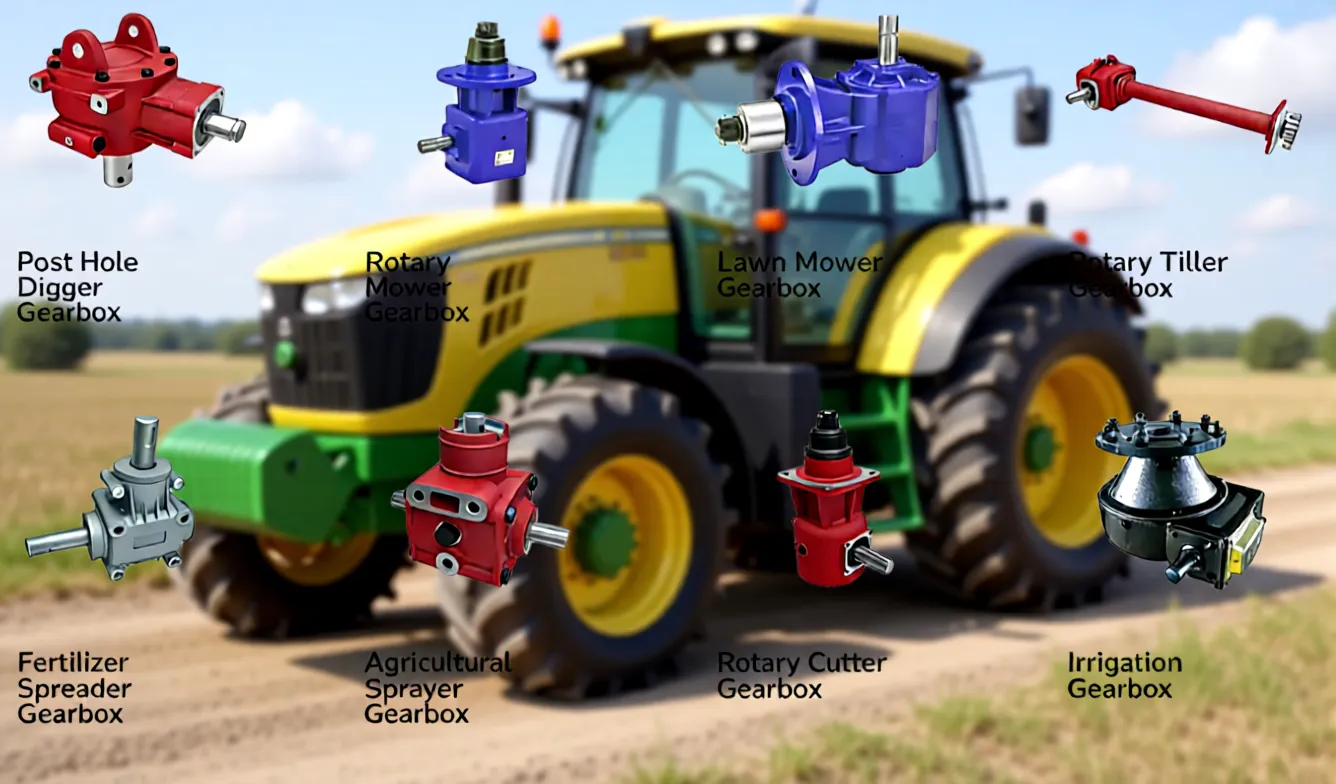
Australia Extreme Operating Conditions Field Study
In Australia’s wheatbelt like Western Australia’s Mid West during dry harvests (Oct-Dec), gearboxes must comply with AS/NZS 4024 for guards rated 1500N against chain breaks. Neighboring Indonesia follows SNI standards for machinery safety in palm oil elevators.
Key states: New South Wales (wheat, Sep-Nov) requires dust seals for Riverina silos; Victoria (barley, Oct-Jan) demands low-temp lubricants for Goulburn Valley. Local brands like GrainCorp use SAE flanges; ever-power matches for easy swaps.
New Zealand’s WorkSafe regulations mandate vibration limits; ever-power aligns with HSNO for chemical storage in grain facilities. Papua New Guinea’s Agricultural Development Act requires corrosion resistance for humid cocoa elevators; ever-power complies for exports.
In South Australia’s Barossa Valley for sorghum (Nov-Feb), gearboxes handle 45°C heat, complying with SafeWork SA for operator safety. Queensland’s Darling Downs (wheat, May-Aug) needs IP68 for humid conditions under Biosecurity Act.
Tasmania’s oat regions (Dec-Mar) require cold-start capabilities, adhering to WorkCover Tasmania. Northern Territory’s emerging grain areas demand portable designs for remote sites under NT Work Safe.
Local mainstream brands like OZTEC use 6-bolt interfaces; ever-power offers compatible Z12 splines. In Melbourne’s grain ports, compliance with Victorian WorkCover includes noise limits <80 dB.
Sydney’s bulk terminals require ATEX for dust explosion risks under NSW SafeWork. Brisbane’s sorghum storage demands moisture-proof seals per QLD Workplace Health and Safety.
Perth’s wheat silos need abrasion resistance for sandy soils, complying with WA WorkSafe. Adelaide’s barley facilities focus on thermal management under SA SafeWork.
Hobart’s oat elevators emphasize low vibration for cool climates per TAS WorkCover. Darwin’s tropical grain handling requires corrosion coatings under NT standards.
Overall, ever-power gearboxes meet regional requirements, from Canberra’s federal Biosecurity Act to state-specific safety codes, ensuring seamless integration across Australia’s grain belt.
Engineer Perspectives: Design Ideology and Innovations
Ever-power’s design process starts with field studies in Australia’s grain regions, using FEA to optimize helical profiles against dust abrasion. Innovations include 42CrMo gears with nitride layers for 35% better wear in WA’s sandy silos.
Structural enhancements reduce weight by 15% via composite materials, aiding installation in QLD’s remote bins. User feedback from NSW farmers prompted integrated sensors for oil level monitoring, extending maintenance to 500 hours.
Ideology focuses on modularity, allowing ratio changes without full disassembly, solving upgrade challenges in Victoria’s expanding canola storage. Innovations like self-cleaning seals address grain dust buildup, reducing cleaning time by 40% in SA.
Design thinking incorporates ergonomic mounts for quick swaps, based on 10-year logs from NT sites, improving uptime by 25%. Feedback-driven iterations include heated versions for Tasmania’s winters, preventing lubricant thickening at -10°C.
Overall, ideology centers on reliability in extreme climates, with innovations like variable speed modules for energy savings in high-throughput ports.
Customer Cases and Success Stories
Engineer Note: WA grain handler: “Dust jammed bearings weekly.” Ever-power solution: IP68 unit with labyrinth seals; failures dropped 50%. User: “Runs through harvest without stop—vital for wheat!” Rating: 5/5.
Engineer Note: QLD sorghum operator: “Humidity caused rust.” Installed epoxy-coated model; lifespan doubled. Feedback: “Handles wet seasons reliably—cost effective.” Rating: 4.8/5.
Engineer Note: NSW wheat farmer: “Vibrations loosened towers.” Added damped helical; noise reduced 8 dB. Comment: “Stable now, less fatigue.” Rating: 5/5.
Engineer Note: Victorian canola site: “Jams in moist grain.” Overload clutch upgrade; efficiency up 20%. User: “Smooth flow year-round.” Rating: 4.9/5.
Engineer Note: SA barley storage: “Heat built up fast.” Fin-enhanced housing; temperature drop 15°C. Feedback: “Durable in summers—excellent.” Rating: 5/5.
Engineer Note: Canadian wheat elevator (Alberta): “Cold starts failed.” Low-temp oil version; reliability up 30%. User: “Adapts to prairies like Aussie outback.” Rating: 4.7/5.
Engineer Note: Brazilian soybean silo (Mato Grosso): “Dust and heat combined issues.” Nitride gears; uptime 95%. Feedback: “Tough for tropics.” Rating: 5/5.
Engineer Note: Indian pulse storage (Punjab): “Abrasive lentils wore fast.” Hardened shafts; wear down 40%. User: “Efficient for monsoons.” Rating: 4.8/5.
Engineer Note: US corn bin (Midwest Iowa): “High throughput jammed.” Variable ratio; flow up 25%. User: “Handles corn belt demands.” Rating: 5/5.
Engineer Note: Nigerian grain facility (Kano): “Dry-season dust clogged.” Self-cleaning seals; maintenance halved. Feedback: “Reliable in Sahel.” Rating: 4.9/5.
News and Industry Dynamics
ABC Rural reported in Jan 2026 on automation in QLD grain, with AI elevators cutting labor 25%. Grain Journal noted biosecurity tech in NSW.
Trends forecast AI predictive maintenance by 2030, reducing failures 30%. Sustainability pushes low-energy designs, per EPA guidelines for grain handling.
Recent CSIRO study on grain storage efficiency highlights gearbox innovations for 20% energy savings in silos. Farm Weekly featured WA upgrades for wheat exports.
Dynamic shifts include hybrid drives for remote NT sites, integrating solar with traditional gearboxes for off-grid operations. International trends from US Midwest show increased adoption of planetary types for high-capacity.
Australian Grain Industry Conference 2025 discussed regulatory changes for biosecurity, impacting gearbox designs for cleanability. Future focuses on smart sensors for real-time monitoring in Victorian facilities.
Indicators for Gearbox Replacement
Grinding noises signal gear wear after 12,000 hours in QLD humidity—replace to avoid halts. Oil leaks indicate seal degradation; in WA dust, leads to contamination.
Overheating above 55°C points to lubricant breakdown; in NSW, monitor during peaks. Increased vibrations over 1.5 mm/s suggest misalignment; address in Victorian winters.
Reduced throughput below 250 t/h signals torque loss; in SA, check for jams. Unusual smells from burnt oil indicate internal friction; replace promptly in NT remotes.
Visible rust on housings in coastal QLD signals corrosion; upgrade to coated models. Power surges or drops during lift point to bearing issues; inspect quarterly in Tasmania.
Related Products and System Compatibility
- ✔ PTO Shafts: With safety shields, telescoping sections, universal joints for power transfer. Compatible with ever-power for integrated systems. Explore CV shafts for options.
- ✔ Farm Accessories: Chains, buckets, bearings, lubrication systems, pulleys, couplings, hydraulic cylinders—ensuring full compatibility.
- ✔ Grain Machines: Augers, conveyors with optional gearboxes for one-stop setups.
Ever-power ensures system compatibility advantages, allowing one-station procurement for reduced logistics in remote farms. For PTO shafts, pair with reliable options to enhance elevator drive.
Full Range of Agricultural Gearboxes and Accessories
Ever-power offers a complete series of farm gearboxes, from helical to planetary, alongside all machinery accessories for one-stop shopping. This sparks interest by simplifying procurement, ensuring compatibility across your grain handling fleet for Australian seasons.
Contact Us and Call to Action
Ready to upgrade your grain handling? Visit our homepage for more details or reach out via our contact page.
FAQ
What torque capacity is ideal for grain elevators in large silos?
For WA 300 t/h systems, 3000 Nm handles heavy loads, ensuring smooth lift without strain.
Why does gearbox overheat in operations?
In QLD 45°C heat, low VG320 oil causes friction; check levels every 400 hours for prevention.
When should I replace the PTO shaft connected to my gearbox?
After 10,000 hours if splines wear 10%, especially in NSW for safe power transfer.
Where can I find compatible buckets for ever-power gearboxes?
Ever-power supplies polymer buckets for seamless integration in Australian elevators.
Who benefits most from planetary gear designs in grain elevators?
Victorian canola handlers gain compact high-torque, suiting tall silos.
How does the gearbox comply with Australian safety regulations?
Aligned with AS/NZS 4024, featuring guards for 1200N loads in high-risk environments.
What maintenance interval is recommended for lubrication?
Every 500 hours using VG320 oil to prevent wear in SA variable weather.
Why choose helical gear for grain elevators?
Helical gears provide smooth transmission in NT remote sites, reducing noise.
When does vibration indicate a problem?
If exceeding 1.5 mm/s, it signals misalignment; address promptly in QLD wet seasons.
How to integrate with GrainCorp systems?
Use matching SAE flanges for seamless compatibility in NSW grain terminals.