
Additive Manufacturing · Precision Feed Drive Solutions
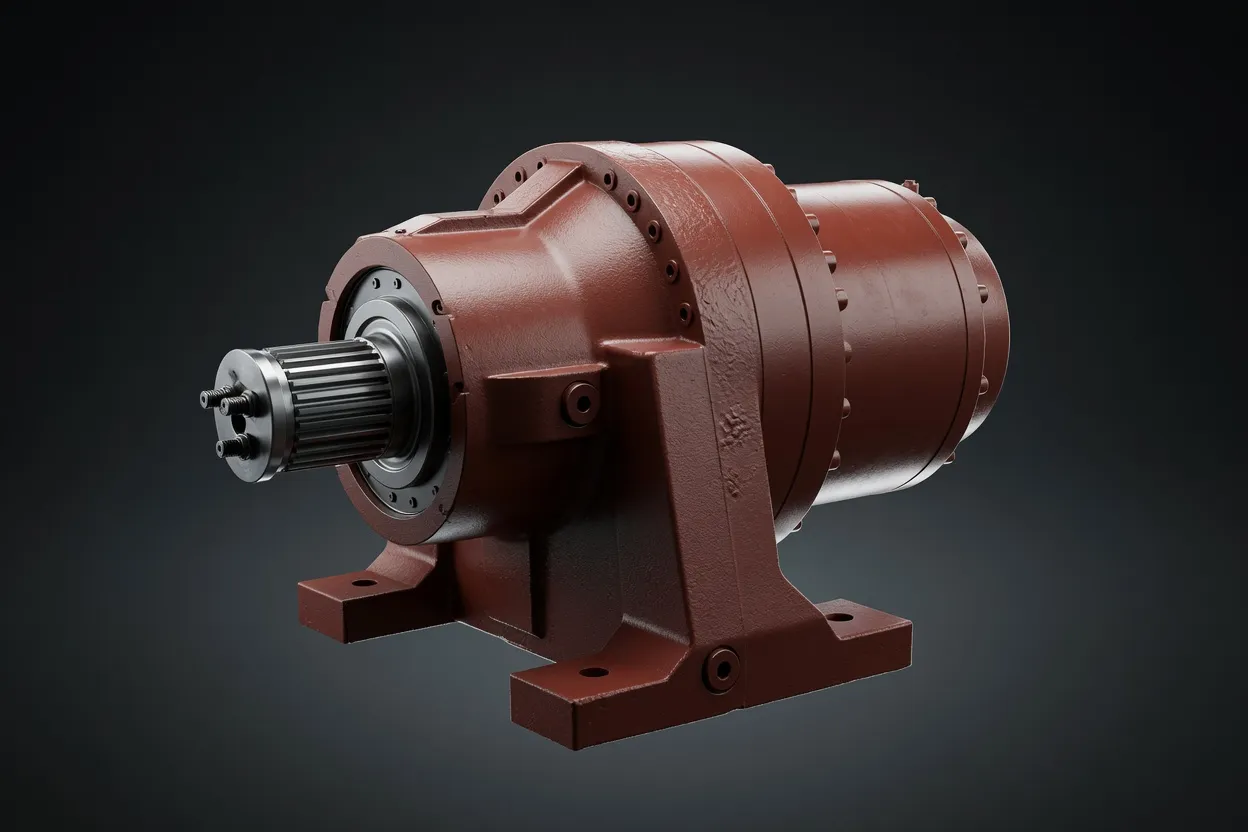
Industrial 3D printers — from large-format FDM systems to pellet-fed extrusion platforms — depend on precisely controlled feed mechanisms to deliver raw material at consistent rates. A planetary gearbox between the feed motor and the drive element (filament gear, auger screw, or pellet feed roller) provides the speed reduction and torque multiplication that maintain uniform material flow across varying back-pressure conditions. This article explores how planetary gear reducers enable reliable feed performance in additive manufacturing systems.
Feed System Architecture in Industrial 3D Printers
Unlike desktop 3D printers that feed 1.75 mm filament through a direct-drive or Bowden extruder, industrial additive manufacturing platforms handle a wider range of feed stock — 2.85 mm filament, polymer pellets, paste materials, or composite-laden filaments reinforced with carbon fiber or glass. Each material type presents different feed resistance characteristics, and the feed motor must overcome this resistance while maintaining volumetric flow accuracy within ±2% to produce dimensionally consistent parts. A planetary gear reducer multiplies the motor’s torque to push material through heated nozzles and long feed paths while allowing the controller to regulate feed rate through precise motor speed commands.
The feed gearbox must also respond quickly to flow-rate changes commanded by the slicer software. During infill printing, the feed rate may be constant, but transitions between infill, perimeters, and bridging segments require rapid flow adjustments — sometimes within 50 milliseconds — to prevent over-extrusion or under-extrusion artifacts. A low-inertia precision planetary gearbox with minimal backlash enables the stepper or servo motor to implement these rapid rate changes without the lag or overshoot that degrade print quality at transition points.
Why Planetary Gearboxes Improve Feed Performance
Torque Multiplication for High-Viscosity Materials
Pellet-fed extruders processing engineering-grade polymers such as PEEK, PEI, or PA12-CF generate back-pressures exceeding 100 bar at the nozzle. The feed auger must overcome this resistance while maintaining a steady rotational speed to deliver consistent volumetric output. A planetary gearbox with a 10:1 to 30:1 ratio multiplies the motor’s available torque by the same factor, enabling a compact NEMA 23 or NEMA 34 stepper motor to power an extruder that would otherwise require a significantly larger and heavier motor, preserving the print head’s dynamic performance during high-speed traverses.
Speed Reduction for Flow Control Precision
Feed rate accuracy depends on the controller’s ability to command small incremental rotations of the feed element. At a 20:1 gear ratio, a stepper motor’s 1.8° full step translates to 0.09° at the feed gear — a resolution improvement that directly reduces the minimum controllable flow increment. For micro-stepping drive systems, this enhancement stacks multiplicatively with the electrical micro-stepping resolution, enabling volumetric flow control precision that supports layer heights below 0.1 mm on large-format platforms where flow consistency is traditionally difficult to maintain.
Smooth Operation for Surface Quality
Stepper motors exhibit inherent torque ripple that creates periodic flow variations visible as surface texture artifacts on printed parts. A planetary gearbox acts as a mechanical low-pass filter, smoothing motor-side torque fluctuations before they reach the feed element. Helical planetary gear sets provide superior smoothing compared to spur-tooth designs, producing printed surfaces with less visible stepping artifact and more uniform layer adhesion across the part’s exterior surfaces, a quality improvement particularly valued in prototyping and end-use part applications.
Gear Ratio Selection for Different Feed Architectures
Filament Drive (Direct Feed)
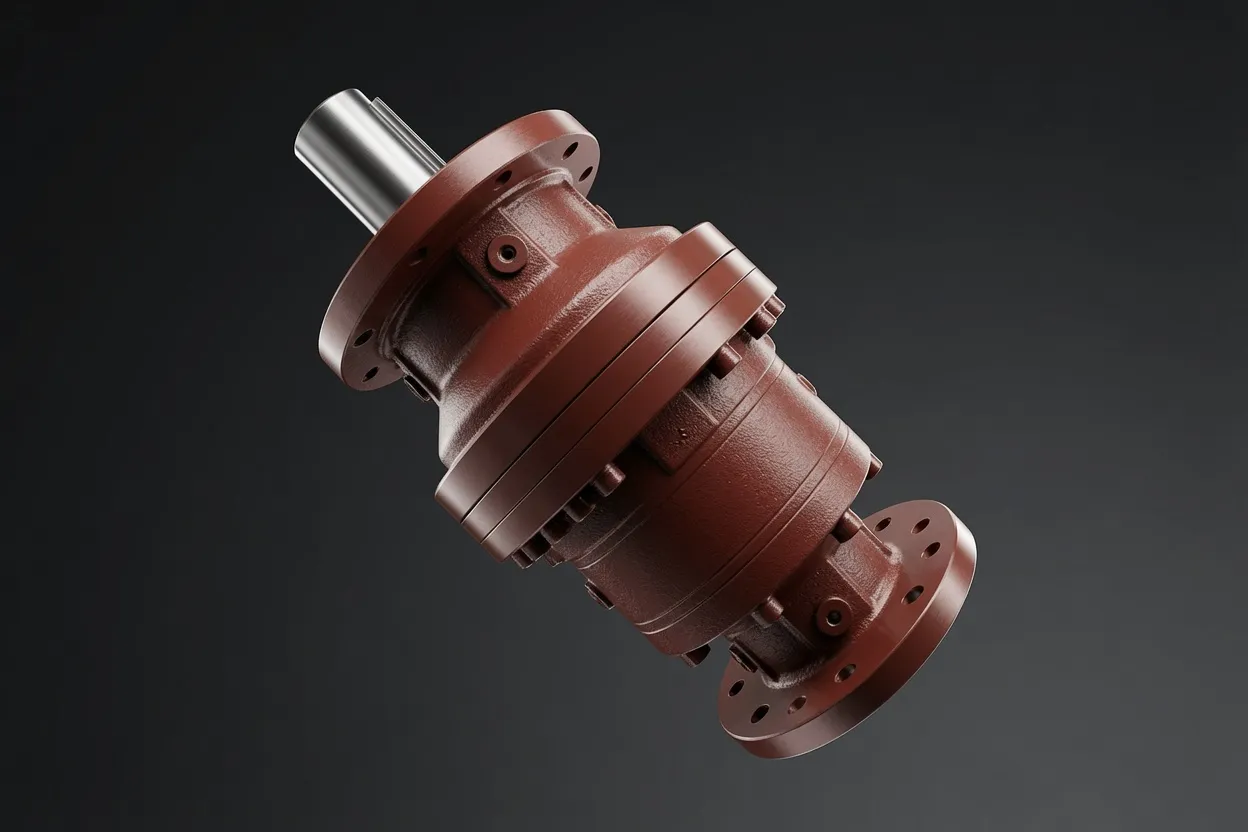
Standard filament extruders using toothed drive gears benefit from ratios of 3:1 to 5:1. These low ratios provide modest torque multiplication while maintaining high feed responsiveness for rapid retraction and prime moves. Low backlash planetary gearbox models with sub-3-arcminute play prevent filament stringing caused by retraction dead zone.
⚙️ Pellet Auger Feed
Pellet extruders with auger-screw feed mechanisms require ratios of 15:1 to 30:1 to generate the high torque needed to push melted polymer through the nozzle at sustained back-pressure. Two-stage planetary units deliver these ratios in compact packages that fit within the print head assembly without adding excessive moving mass.
Paste and Ceramic Extrusion
Paste-based systems dispensing ceramic slurries or bioprinting hydrogels use ratios of 20:1 to 50:1 with very low output speeds — often below 10 RPM. The gearbox must maintain smooth, cogging-free rotation at these extremely low speeds to prevent pulsation in the deposited bead. Helical gearing with precision-ground teeth minimizes low-speed torque irregularity.
️ Large-Format Pellet Systems
Industrial-scale pellet printers producing parts exceeding 1 meter in length use ratios of 20:1 to 40:1 with high-power servo motors. The gearbox must handle continuous duty at elevated torques for print jobs lasting 24 hours or more, requiring thermal ratings adequate for sustained full-load operation without overheating.
Mechanical Integration on the Print Head
Weight and Inertia Budget
The gearbox adds mass to the moving print head assembly. For Cartesian and CoreXY printers, every additional gram on the print head reduces achievable acceleration and increases ringing artifacts at direction changes. Select the smallest planetary gearbox frame size that meets the torque requirement, and consider lightweight aluminum or titanium housing options when available.
Motor Coupling Method
Use a zero-backlash beam or bellows coupling between the motor shaft and the gearbox input. Set-screw couplings loosen under the vibration generated during rapid print-head traverses, causing intermittent feed failures that are difficult to diagnose because they appear as random under-extrusion events.
Thermal Isolation
On heated-chamber 3D printers operating above 60 °C ambient, the gearbox and motor are exposed to elevated temperatures that can exceed the lubricant’s rated range. Install a thermal barrier (ceramic or fiberglass spacer) between the extruder hot end and the gearbox mounting bracket, and verify that the gearbox’s lubricant is rated for the expected operating temperature inside the chamber.
Electrical Noise Shielding
Stepper motor cables routed alongside the gearbox housing can radiate electromagnetic interference to nearby thermistor or endstop signal wires. Use shielded motor cables and maintain at least 20 mm separation from signal conductors to prevent false temperature readings or missed endstop triggers caused by motor-switching noise.
Maintenance and Longevity in Additive Manufacturing
Lubrication Considerations for Heated Environments
Industrial 3D printers with heated build chambers maintain ambient temperatures of 60 to 120 °C during print jobs. Standard gearbox lubricants rated for 80 °C maximum will degrade rapidly in these conditions. Specify a high-temperature synthetic grease — PFPE-based lubricants maintain their properties up to 200 °C — for gearboxes operating inside heated chambers. Even for open-frame printers, the radiant heat from a 400 °C nozzle can raise gearbox housing temperatures above standard lubricant limits if the mounting bracket conducts heat from the hot end into the reducer housing.
Feed Gear Wear and Backlash Monitoring
As the feed gear teeth wear from contact with abrasive composite filaments — carbon fiber, glass fiber, or metal-filled — the effective drive diameter decreases, reducing extrusion rate per motor revolution. Combine this mechanical wear with any backlash increase in the planetary gearbox, and the cumulative effect can shift extrusion calibration enough to produce dimensional errors exceeding ±0.2 mm on large parts. Schedule a quarterly extrusion calibration test: command a known length of filament and measure the actual amount extruded. Recalibrate the controller’s steps-per-mm parameter when the deviation exceeds 1%.
Why Choose Ever-Power for 3D Printer Feed Gearboxes
Miniature and Standard Frame Sizes
Our planetary gearbox range starts at 22 mm frame diameter for compact print head installations and scales to 90 mm for industrial pellet extruder platforms. Every frame size shares the same precision gear manufacturing process, ensuring consistent quality regardless of scale.
Low Cogging Torque Verification
We test and certify cogging torque on every unit designated for 3D printer feed applications. Verified low-cogging performance ensures smooth material flow at the low output speeds characteristic of additive manufacturing feed systems.
️
NEMA and Custom Motor Interfaces
Standard NEMA 17, NEMA 23, and NEMA 34 motor flanges are available off the shelf. Custom input interfaces for servo motors or non-standard steppers are delivered within 10 business days, with 3D CAD models provided for integration into your print head design.
Maker-Friendly Ordering
From single-unit prototype orders to 500+ unit OEM batches, we support additive manufacturing companies at every production scale. No minimum order quantity for standard catalog items. Contact [email protected] for pricing and availability.
Frequently Asked Questions
Upgrade Your 3D Printer Feed System
Share your extruder design, material type, and feed rate requirements — our engineers will recommend the ideal gearbox for consistent, high-quality prints.