
Wind Energy · Blade Pitch Control Drive Systems
The pitch system adjusts the angle of each rotor blade relative to the incoming wind, controlling the aerodynamic forces that determine rotor speed, power output, and structural loads. Each blade’s pitch drive — typically an electric motor coupled to a planetary gearbox driving a slewing bearing — must respond within seconds to control commands during normal power regulation and within fractions of a second during emergency feathering. This article explores how planetary gearbox engineering meets the performance, safety, and environmental demands of wind turbine pitch drive applications.
Pitch System Architecture and Gearbox Role
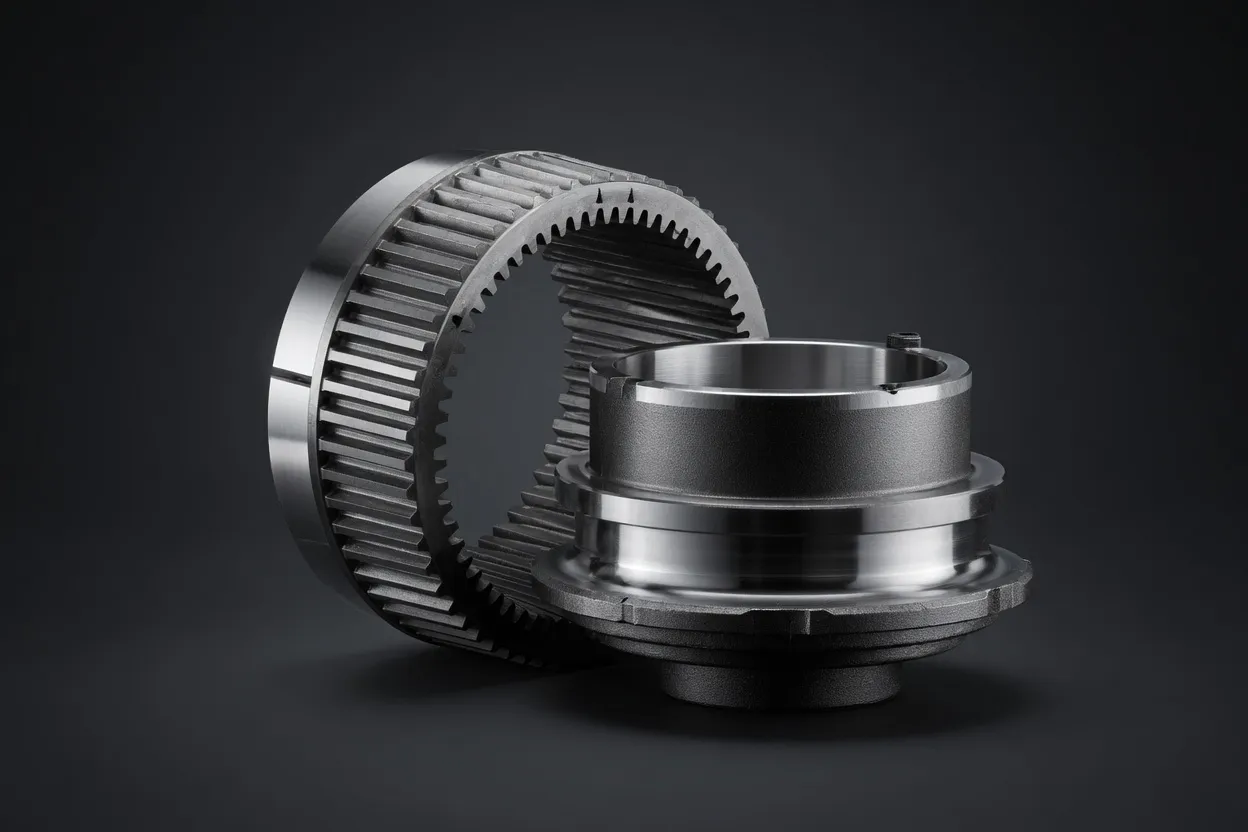
Each blade of a modern wind turbine is independently pitched by its own dedicated drive system, providing redundancy — if one pitch drive fails, the remaining two can still feather their blades to bring the rotor to a safe speed. The drive module houses an electric motor (AC or DC, depending on the turbine design), a multi-stage planetary gear reducer with a ratio of 500:1 to 1,500:1, and an output pinion that meshes with the blade bearing’s internal ring gear. A battery-backed power supply ensures that the pitch system can feather the blades during grid power loss — a critical safety function that prevents rotor overspeed.
During normal operation above rated wind speed, the pitch controller adjusts blade angles continuously — often several times per second — to maintain constant rotor speed and generator power. These adjustments are small, typically ±2 degrees, but they must be executed with minimal delay and high positional accuracy to prevent power fluctuations and structural load excursions. The planetary gearbox’s combination of high ratio (for torque multiplication and fine angular resolution) and low backlash (for precise position control) makes it well-suited for this demanding control application.
Performance Requirements for Pitch Drive Gearboxes
Response Speed and Positioning Accuracy
The pitch controller commands blade-angle changes at rates up to 8 degrees per second during normal operation and up to 15 degrees per second during emergency feathering (rotating the blade 90° from operating position to the feathered, no-lift position). The precision planetary gearbox must accelerate its output to full pitching speed within 0.2 seconds of receiving the command, requiring low rotational inertia in the motor and gear train. Positioning accuracy within ±0.1° at the blade root ensures that all three blades operate at matched aerodynamic angles, preventing rotor imbalance that would excite tower vibration.
Emergency Feathering Reliability
Emergency feathering is the primary safety mechanism that prevents rotor overspeed in high-wind or fault conditions. The pitch drive must complete a full 90° blade rotation within 8 to 12 seconds under all conditions — including low battery voltage, extreme cold, and maximum blade aerodynamic loading. The gearbox is sized with a 200% torque margin above the maximum blade pitching moment to ensure this safety function operates reliably even with degraded battery voltage or partially depleted grease. Failure to feather even one blade can result in catastrophic rotor overspeed and structural failure of the turbine.
Oscillatory Duty Cycle
Unlike most gearbox applications that involve sustained rotation, pitch drives operate in an oscillatory mode — constantly reversing direction through small angular increments. This duty cycle imposes unique wear patterns on the gear teeth, loading both flanks alternately rather than wearing one flank preferentially. A planetary gear reducer with symmetric tooth profiles and equal surface hardness on both flanks handles this bidirectional loading without the asymmetric wear that would progressively increase backlash and degrade pitch control accuracy over the turbine’s service life.
Design Considerations for Pitch Gearboxes
⚙️ Multi-Stage Ratio Architecture
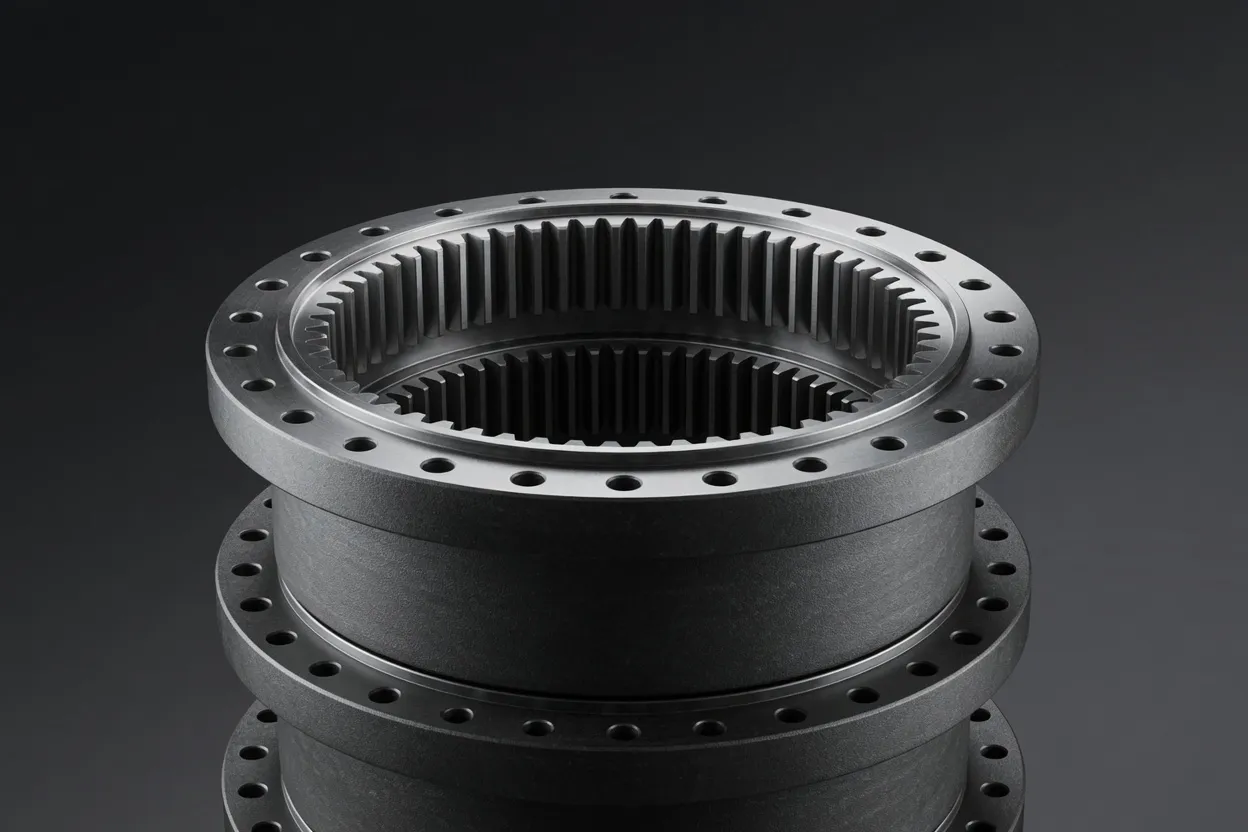
Three or four planetary stages achieve the 500:1 to 1,500:1 overall ratio required for pitch drives. The first stage handles the highest torque at the output end, using wider gears and larger bearings than the subsequent stages. Stage-by-stage ratio distribution is optimized to balance torque capacity against package length, fitting the module within the blade root’s limited radial space.
Output Pinion Design
The output pinion meshes with the blade bearing’s ring gear — a large-diameter, low-module gear that forms the rotational interface between the blade and hub. The pinion must be case-carburized to 58+ HRC surface hardness and ground to AGMA Class 10 or higher. Field-replaceable pinion designs allow worn pinions to be swapped without removing the entire gearbox from the hub.
️ Sealing Against Hub Environment
Pitch gearboxes operate inside the rotor hub, which is exposed to rain, ice, salt spray (offshore turbines), and temperature extremes. IP65 sealing minimum; offshore installations require IP67. Corrosion-resistant housing treatments (e-coating or powder coating) and stainless-steel output shafts extend service life in marine atmospheres.
️ Wide Temperature Range
Pitch drives must operate from –30 °C in winter to +60 °C in summer sun-heated hub interiors. Synthetic lubricants with pour points below –40 °C and viscosity indices above 150 maintain film-forming capability across this range without requiring seasonal lubricant changes.
Blade Root Integration and Installation
Hub Interface Preparation
Machine the pitch drive mounting surface on the hub casting to ensure flatness within 50 μm over the gearbox footprint. Verify the blade bearing ring gear’s tooth quality and concentricity by measuring backlash with a reference pinion at multiple circumferential positions before installing the production drive module.
Gearbox Module Installation
Install the motor-gearbox-pinion assembly on the hub using precision dowel pins for radial location and high-strength bolts torqued to the manufacturer’s specification. Verify pinion-ring gear backlash at three positions (120° apart around the blade bearing) and confirm the contact pattern covers at least 65% of the tooth face width.
Battery Backup Verification
After installing the pitch drive, test the emergency feathering function using battery power alone — disconnecting the grid supply and commanding a full 90° pitch movement. Measure the feathering time and verify it meets the turbine’s safety system specification. This test must be repeated annually as part of the turbine’s safety inspection.
Control System Integration
Configure the pitch controller’s PID gains, position feedback scaling, and torque limits for the specific gearbox ratio and motor combination. Run the blade through its full pitch range at reduced speed to verify position feedback accuracy and identify any dead zones or binding that could affect control performance during normal operation.
Maintenance Practices for Pitch Drive Longevity
Grease Management for Oscillatory Duty
Pitch gearbox grease is subjected to repetitive shearing in a narrow angular zone rather than the full-rotation mixing that occurs in continuous-duty applications. This localized shearing can cause grease thickener breakdown and base-oil separation in the most-used zone while leaving grease in less-used areas relatively fresh. Semi-annual grease replenishment — adding fresh grease to flush degraded material from the high-use zone — maintains lubrication quality throughout the gear train. Use only the grease grade specified by the gearbox manufacturer; mixing incompatible thickener types causes softening and loss of the grease’s load-carrying capacity.
Backlash and Positioning Accuracy Checks
Annual backlash measurement at the pinion-ring gear interface detects wear progression that could affect pitch control accuracy. Command the blade to a fixed angle, then apply a known torque to the blade in both pitch directions using a hydraulic cylinder, measuring the resulting angular displacement. Compare to the original commissioning value. When backlash exceeds the pitch controller’s compensation range, schedule a pinion replacement or gearbox exchange. For offshore turbines where access is weather-dependent, predictive trending based on annual measurements helps schedule replacements months in advance during favorable weather windows.
Why Choose Ever-Power for Pitch Drive Gearboxes
Safety-Critical Manufacturing Standards
Our pitch drive gearboxes are manufactured under quality procedures aligned with IEC 61400-4 requirements for wind turbine gearbox components. Every unit receives 100% dimensional inspection, material certification, and functional verification before release — the level of documentation required for safety-critical pitch system components.
Oscillatory Duty Validation
We validate pitch gearbox designs through accelerated oscillatory testing that simulates 20 years of blade pitching duty, including emergency feathering events, cold-start cycles, and sustained maximum-torque operation. Test results are available to OEM customers for integration into their turbine design validation dossier.
️
Onshore and Offshore Variants
Our product range includes standard onshore models (IP65, standard coating) and enhanced offshore models (IP67, marine-grade corrosion protection, stainless-steel output components) — both sharing the same core gear train design for maximum part commonality and simplified logistics.
Service Exchange Program
We maintain a pool of factory-rebuilt pitch drive modules available for immediate dispatch as exchange units, minimizing turbine downtime during field replacements. Return your removed module for refurbishment and credit against the exchange fee.
Frequently Asked Questions
Ensure Reliable Blade Pitch Control
Share your turbine model, blade bearing data, and volume requirements — our pitch drive team will deliver a complete technical and commercial proposal.