
Printing Industry · Press Roll Drive Solutions
High-speed web and sheet-fed printing presses depend on precisely synchronized roll drives to maintain color registration, web tension, and print quality at speeds exceeding 15 m/s. Planetary gearboxes between servo motors and impression, anilox, and transport rolls must deliver ultra-low backlash and minimal torsional wind-up to keep multi-color registration within ±0.05 mm tolerance. This article covers planetary gearbox engineering for printing press roll drive applications.
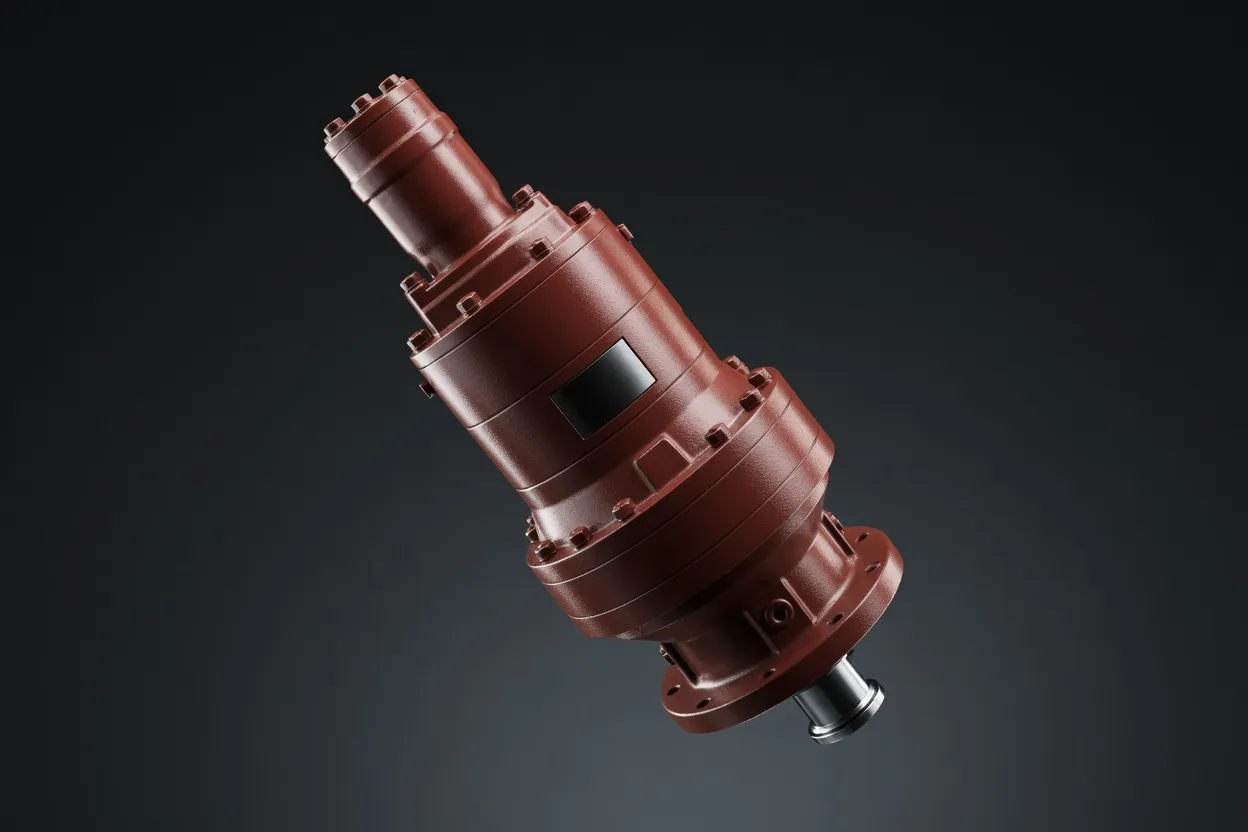
Roll Drive Architecture in Modern Presses
Modern presses use individual servo drives (shaftless technology) on each print unit, replacing the traditional mechanical line shaft with electronic synchronization. Each servo motor couples to a low backlash planetary gearbox that steps the motor speed down to match the impression cylinder’s surface speed — typically 100–300 RPM for web-offset and flexographic presses. Ratios of 3:1 to 10:1 are common, with the gearbox providing the torque needed to overcome the nip pressure, ink tack forces, and web tension at each print station while maintaining angular position accuracy within 0.01° of the master reference.
Color registration — the alignment of successive ink layers to within ±0.05 mm — depends directly on the angular accuracy of each impression cylinder relative to the others. Any backlash in the gearbox creates a phase error at the cylinder surface that shifts the printed image, producing visible misregistration. A precision planetary gearbox with angular backlash below 1 arcminute and torsional stiffness above 200 Nm/arcmin ensures that the servo controller’s electronic synchronization commands produce the intended physical cylinder positions with negligible mechanical error.
Critical Performance Parameters
Angular Transmission Accuracy
Transmission error — the deviation of the actual output angle from the theoretical angle based on the input angle and ratio — must be below 30 arcseconds peak-to-peak for high-quality multi-color printing. This requires gears ground to AGMA Class 12 or higher, with profile and lead errors within 3 μm. Higher transmission error creates periodic speed variations at the print cylinder surface, producing banding defects visible in solid-color areas and halftone screens.
Torsional Stiffness for Registration
When the nip load changes — as paper thickness varies across the web width, or as the press accelerates and decelerates — the impression cylinder torque fluctuates. If the gearbox has insufficient torsional stiffness, these torque variations cause angular deflection that shifts the print image. Stiffness above 200 Nm/arcmin for medium-format presses and above 400 Nm/arcmin for wide-format presses keeps torque-induced registration errors below 0.02 mm — well within the ±0.05 mm tolerance required for commercial print quality.
Gearbox Selection for Different Press Types
Web Offset
Ratios 5:1 to 8:1, backlash below 1 arcminute, stiffness above 300 Nm/arcmin. High input speeds (motor up to 4,000 RPM) demand helical gearing with precision balance for smooth, vibration-free operation at sustained press speeds.
️ Flexographic
Ratios 3:1 to 6:1, backlash below 2 arcminutes. Flexo presses run at lower pressures than offset but require rapid speed changes during job changeovers. Low inertia gearboxes enable faster acceleration, reducing web waste during setup.
Sheet-Fed Offset
Ratios 5:1 to 10:1, backlash below 1 arcminute. Sheet-fed presses require precise sheet-to-cylinder timing synchronized to the feeder and delivery mechanisms. Gearbox backlash directly affects sheet-to-image registration.
️ Digital Hybrid
Ratios 3:1 to 5:1, backlash below 3 arcminutes. Digital-hybrid presses combine conventional print stations with digital heads. The conventional stations require the same gearbox precision as standalone presses to maintain registration between conventional and digital layers.
Installation and Alignment for Print Quality
Coupling Selection
Use zero-backlash disc or bellows couplings between the gearbox and impression cylinder journal. Flexible jaw couplings add torsional compliance that degrades registration performance. The coupling’s torsional stiffness should be at least 5× the gearbox’s rated stiffness to avoid limiting the system bandwidth.
Concentricity Verification
Align the motor shaft, gearbox input, gearbox output, and cylinder journal to within 0.02 mm total concentricity. Use laser alignment tools for accurate measurement. Misalignment causes periodic torque variations at the cylinder that produce print-density banding synchronized to the gearbox rotation.
Servo Tuning for Registration
Tune the servo loop with the press running at production speed under loaded conditions. Optimize the position-loop gain for minimum following error during steady-state printing, and add notch filters if the system exhibits resonance from the gearbox-cylinder mechanical coupling.
Registration Verification
After gearbox installation, run a multi-color registration test pattern at production speed. Measure color-to-color registration at multiple positions across the web width. All measurements must fall within the press’s specified registration tolerance before releasing for production.
Maintenance for Consistent Print Quality
Printing press gearboxes are sealed lifetime-lubricated units requiring no scheduled maintenance under normal conditions. The primary monitoring parameter is registration quality — gradual degradation of color registration accuracy over time may indicate increasing gearbox backlash or bearing wear. Annual backlash measurement using the press’s built-in registration measurement system (or an external rotary encoder) provides trending data that predicts the optimal replacement timing. Most press gearboxes maintain specification for 40,000+ operating hours, covering 10–15 years of typical two-shift press operation.
Why Choose Ever-Power for Printing Press Gearboxes
AGMA 12+ Gear Quality
Our gear grinding lines achieve the tooth-quality grade required for sub-30-arcsecond transmission error, meeting the registration accuracy demands of commercial multi-color printing at speeds up to 20 m/s.
Transmission Error Measurement
We measure and certify single-flank transmission error on every press-grade gearbox, providing documented proof that each unit meets the angular accuracy specification your press design requires.
️
Press OEM Collaboration
We work with press manufacturers from the design phase, optimizing gearbox stiffness, inertia, and ratio for each print unit’s specific registration and speed requirements.
Global Press Industry Supply
We deliver press gearboxes to printing press OEMs and retrofit customers in Europe, Asia, and the Americas, with technical support in multiple time zones.
Frequently Asked Questions
Achieve Perfect Registration on Every Print Run
Share your press configuration, speed range, and registration targets — our team will specify the ideal gearbox for each print unit.