
Solar Energy · Tracker Drive Gear Technology
Solar tracking systems tilt photovoltaic panels to follow the sun’s arc across the sky, capturing up to 25–40% more energy than fixed-tilt installations. The drive mechanism at each tracker row — typically a slewing drive incorporating a planetary gearbox and worm gear — must deliver precise angular positioning, withstand wind and snow loads, and operate maintenance-free in outdoor environments for 25 years or more. This article details how planetary gearbox technology enables reliable, cost-effective solar tracker drive systems.
Solar Tracker Types and Drive Requirements
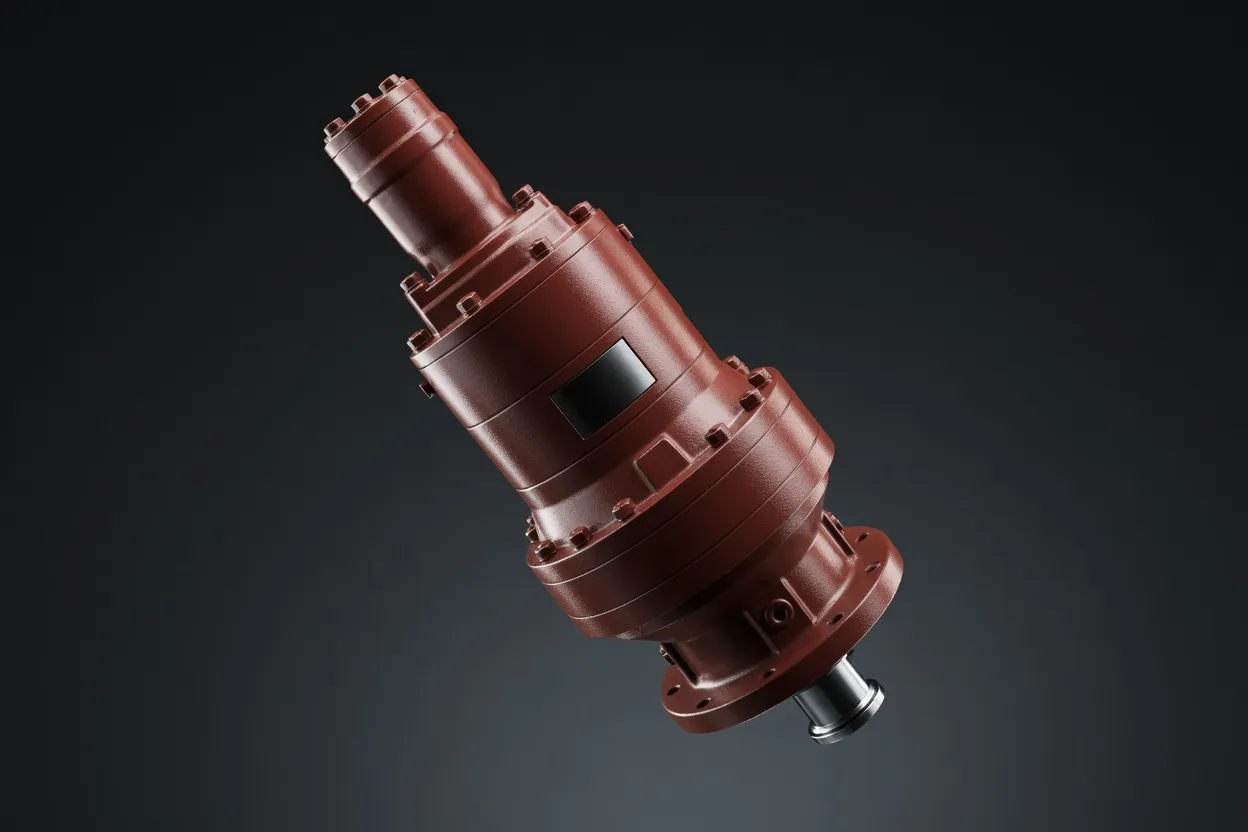
Utility-scale solar farms predominantly use single-axis horizontal trackers that rotate panels east to west around a horizontal torque tube. Each tracker row — spanning 30 to 90 meters — is driven by one or two solar tracker planetary gearbox units mounted at the torque tube’s center or distributed along its length. The drive must rotate the panel array through approximately 120° of daily travel (±60° from vertical), moving at a rate of 0.5 to 2 degrees per minute during normal sun tracking and up to 10 degrees per minute during storm-stow maneuvers that return the panels to a flat defensive position to reduce wind loading.
Dual-axis trackers, used primarily in concentrated solar power (CSP) and high-value rooftop installations, add an elevation axis to the azimuth tracking, following the sun’s seasonal altitude changes as well as its daily east-west movement. Each axis uses its own planetary gear reducer, with the azimuth drive handling the heavier panel load and larger rotation range, and the elevation drive managing a smaller angular range but requiring finer positioning accuracy for optimal energy collection. The drive must hold the panels at the commanded angle against wind gusts without continuous motor power, relying on the gearbox’s self-locking properties to maintain position between tracking increments.
Engineering Demands Specific to Solar Tracker Drives
Self-Locking Torque Retention
Solar panels present a large wind-catch area — a single tracker row may span 200 square meters. Wind loads during gusts can reach 2,000 N/m² on the panel surface, generating substantial torques at the drive unit. The gearbox must hold the panel at its tracking angle without consuming electrical power between tracking movements. High-ratio planetary-worm hybrid gearboxes (with the worm stage at the output) achieve reliable self-locking, preventing wind from back-driving the panels. Pure planetary designs require additional holding mechanisms — motor brakes or friction clamps — to achieve the same wind-load retention, adding cost and maintenance requirements.
Outdoor Environmental Durability
Solar tracker drives operate outdoors in direct sun, rain, dust, and temperature extremes year-round. Installations in desert regions experience daily temperature swings of 40 °C or more, UV radiation that degrades exposed polymer components, and fine sand that infiltrates poorly sealed housings. Coastal installations face salt-spray corrosion. The gearbox must carry IP65 protection minimum (IP66 recommended for desert sand environments), with corrosion-resistant housing coatings, UV-stabilized seal materials, and lubricants with low evaporation rates that maintain fill levels over multi-year intervals between maintenance visits.
25-Year Design Life with Minimal Maintenance
Solar power plant economics depend on low operations and maintenance (O&M) costs over a 25-year project life. The tracker drive gearbox must operate throughout this period with no more than annual visual inspections and grease replenishment every 5 years. This maintenance-free expectation rules out designs with wear-limited components (such as elastomeric couplings or unsealed bearings) that would require replacement within the project life. Sealed-for-life bearings, corrosion-resistant gear materials, and synthetic grease fills rated for 30,000+ hours form the foundation of a 25-year tracker gearbox design.
Gearbox Architecture for Single-Axis Trackers
⚙️ Planetary-Worm Hybrid Design
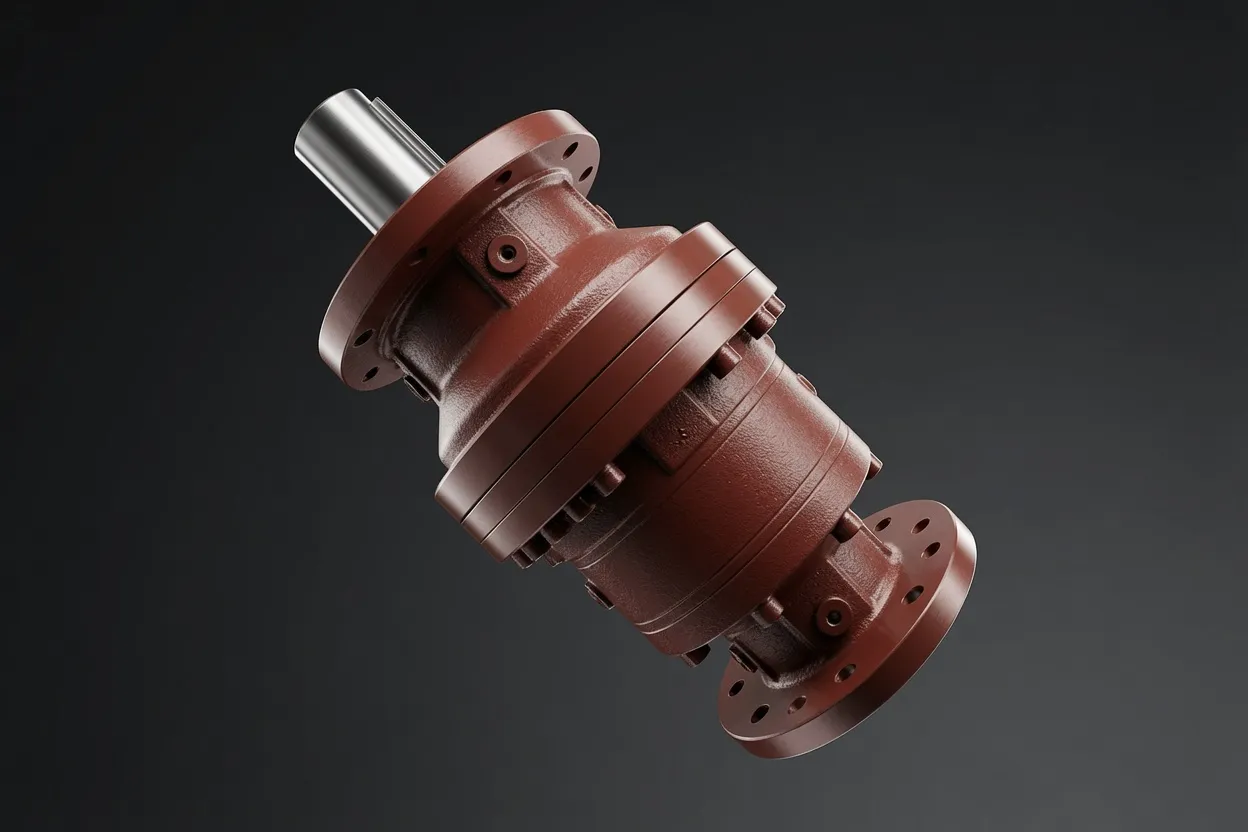
The most common tracker drive configuration pairs one or two planetary stages (for torque multiplication and efficiency) with a worm output stage (for self-locking). The planetary stages provide 10:1 to 30:1 ratio with 95%+ efficiency, while the worm stage adds another 20:1 to 50:1 with inherent self-locking behavior. The overall ratio of 500:1 to 1,500:1 converts a small 0.5–1.5 kW motor’s output into the thousands of newton-meters of holding torque needed to resist wind loads on a full-length tracker row.
Slewing Drive Integration
Many tracker drives package the gearbox and output bearing into a single slewing-drive unit. The slewing bearing’s large-diameter, thin-section design mounts directly to the torque tube support structure, and the internal gear of the bearing is driven by the gearbox’s output pinion. This integrated approach eliminates the external gearbox-to-structure coupling and reduces the number of installation steps in the field.
Torque Tube Interface
The drive output connects to the tracker’s torque tube — a steel tube that spans the full row length and transmits the drive torque to all panels. The connection must handle the combined torsion, bending, and thrust loads without slip or backlash. Splined or clamped connections with anti-rotation devices prevent relative movement between the drive and torque tube under oscillating wind loads.
️ Thermal Rating for Desert Conditions
Trackers in arid regions operate with housing temperatures exceeding 70 °C during midday summer conditions. The gearbox lubricant must retain adequate viscosity and EP additive performance at these temperatures while resisting oxidation over the 5-year lubricant service interval. PFPE or high-VI PAO greases provide the required thermal stability without the evaporation losses that would deplete conventional grease fills within a year or two in desert heat.
Selection Guide for Solar Tracker Gearboxes
Choosing the right tracker drive gearbox involves matching the unit’s torque capacity, speed capability, and self-locking performance to the tracker row’s mechanical requirements. Start by calculating the maximum wind-load torque at the drive axis using the project’s site-specific wind study data, which provides the design wind pressure for the panel structure at the installation’s terrain category and height. Multiply the wind pressure by the panel area and the moment arm to the drive axis to obtain the maximum torque the gearbox must resist. Apply a safety factor of 1.5 to 2.0 (depending on the structural code governing the installation) to determine the gearbox’s required rated torque capacity.
For tracking speed, confirm that the gearbox-motor combination can achieve the storm-stow speed — typically 10°/min — required to return the panels to the flat position within the time window specified by the tracker controller. During normal tracking, the drive operates at roughly 1°/min, well within the gearbox’s speed capability. A planetary gearbox selection guide provided by the manufacturer should include torque-speed curves, efficiency maps, and thermal ratings at various ambient temperatures to support this engineering evaluation. Our technical team at Ever-Power provides this documentation for every model in our tracker drive range, simplifying the selection process for solar EPC contractors and tracker OEMs.
Installation and Commissioning on Solar Sites
Foundation and Pier Preparation
The drive module mounts on the tracker’s central pier or support structure. Verify that the mounting surface is level within ±0.5° and that the pier’s structural capacity exceeds the combined weight of the drive module, torque tube, panels, and the maximum wind reaction force. Uneven mounting surfaces introduce bending loads into the gearbox housing that accelerate bearing wear and seal fatigue.
Drive Module Installation
Lift the drive module into position using a crane or telehandler, align the torque tube coupling, and secure the mounting bolts. Torque all fasteners to the manufacturer’s specification. For slewing-drive-type units, verify the slewing bearing’s preload by measuring starting torque before connecting the torque tube — low preload indicates a potential rattling issue under wind oscillation.
Electrical and Control Wiring
Connect the drive motor to the tracker controller, verifying phase rotation (for AC motors) or polarity (for DC motors) before energizing. Program the controller with the site’s geographic coordinates, time zone, and tracker row orientation so the tracking algorithm calculates the correct sun position throughout the year. Run a manual east-to-west sweep to confirm correct rotation direction and limit-switch positions.
Storm-Stow Function Test
Trigger the storm-stow function from the tracker controller and verify that the drive returns the panels to the flat position within the specified time — typically 3 to 5 minutes for a full 120° rotation. This test validates that the motor has adequate power to drive the full panel array at stow speed against any gravity and friction forces, and that the controller correctly identifies the stow position and stops the motor without overshooting.
Maintenance Planning for 25-Year Operation
Solar tracker drives are designed for minimal maintenance, but a structured inspection program extends reliability through the full project life. Annual visual inspections — checking for housing corrosion, seal integrity, lubricant leakage, and loose fasteners — catch developing issues before they progress to functional failure. Every 5 years, replenish the gearbox grease using the manufacturer’s specified grade and quantity; over-greasing can increase seal pressure and cause leakage, while under-greasing accelerates gear wear. For installations in aggressive environments (desert sand, coastal salt), increase the inspection frequency to semi-annual and the grease interval to every 3 years.
Tracker fleet operators managing thousands of drive units benefit from condition-based monitoring approaches. Motor current trending during normal tracking moves serves as a low-cost health indicator — a gradual increase in current over months suggests increasing internal friction from wear or lubricant degradation. Sudden current spikes may indicate debris ingress or bearing damage. Integrating this current data into the tracker controller’s SCADA system enables automated alerting when individual drives show anomalous behavior, directing field technicians to the specific unit for targeted inspection rather than blanket maintenance across the entire fleet.
Why Choose Ever-Power for Solar Tracker Gearboxes
Utility-Scale Production Volume
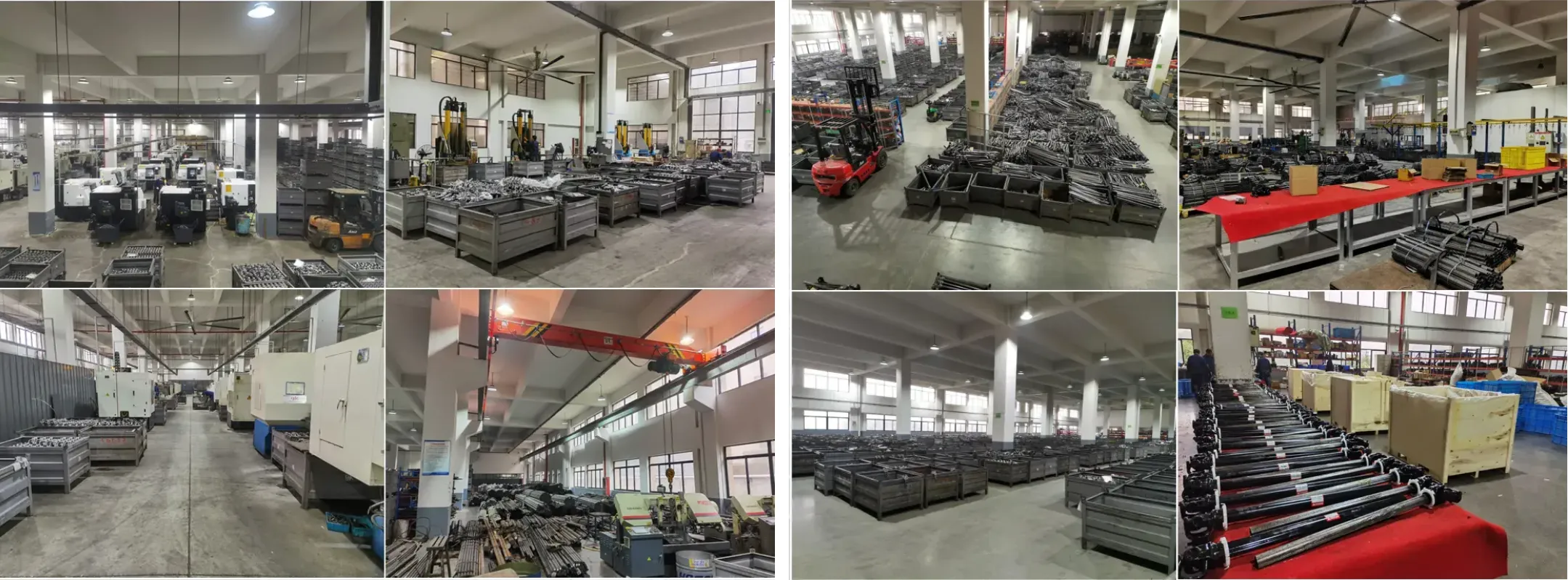
Our tracker drive gearbox production capacity exceeds 20,000 units per year, supporting utility-scale solar projects with hundreds of tracker rows. Consistent quality across high volumes ensures uniform tracking performance across the entire solar field.
25-Year Durability Validation
Every tracker gearbox model completes a 25-year-equivalent accelerated life test — including thermal cycling, wind-load simulation, and corrosion exposure — before product release. Test reports are available for inclusion in your project’s engineering documentation package.
️
Site-Specific Engineering Support
Provide your project’s wind data, panel layout, and tracker geometry — our application engineers will calculate drive torque requirements, select the optimal gearbox model, and provide a technical datasheet customized to your site conditions. This planetary gearbox selection guide service is complimentary for project quantities above 100 units.
Project-Phased Delivery
Large solar projects are built in phases over 6 to 18 months. We schedule gearbox production and delivery to match your construction phases, storing finished units in our warehouse until your site is ready to receive them — eliminating field-storage risk while ensuring just-in-time availability for each construction phase.
Frequently Asked Questions
Power Your Solar Project with Reliable Tracker Drives
Share your project location, tracker layout, and panel specifications — our solar energy team will deliver a complete drive system proposal with site-specific engineering data.