
Oil & Gas · Drilling Rig Planetary Drive Systems
Oil, gas, and geothermal drilling rigs use planetary gearboxes in the top drive, drawworks, mud pump, and rotary table — the four primary torque-delivery systems that make wellbore construction possible. Each application imposes distinct torque, speed, and reliability demands on the planetary gear train. This article covers the engineering requirements and maintenance practices for planetary gearboxes across the major drive systems found on modern drilling rigs.
Top Drive Systems and Planetary Gearbox Requirements
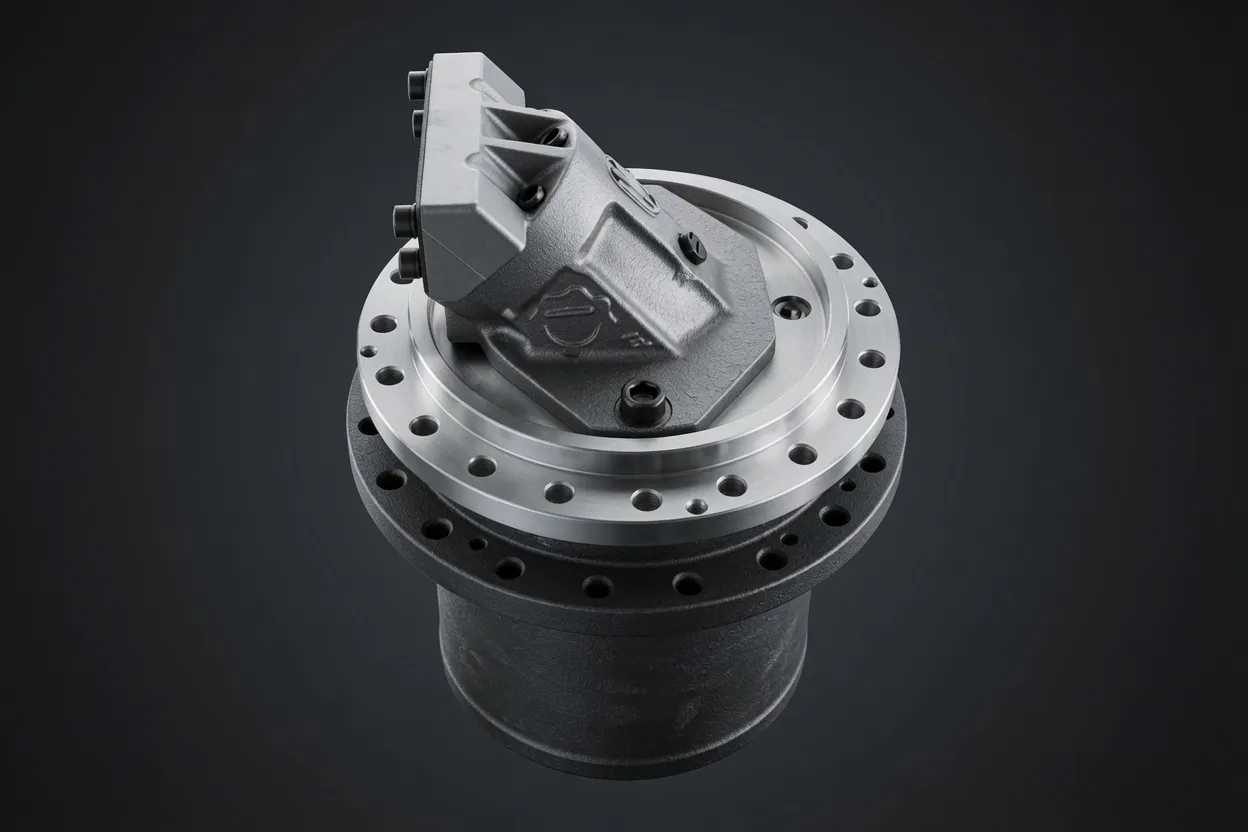
The top drive replaces the traditional rotary table and Kelly as the primary means of rotating the drill string. A pair of AC electric motors or hydraulic motors power a planetary gear reducer with a ratio of 4:1 to 8:1, delivering 30,000 to 80,000 Nm of continuous output torque at 60–200 RPM to the drill string. The top drive travels vertically on the rig’s mast, carrying its own weight (15–30 tonnes) plus the weight of the drill string (up to 500 tonnes in deep wells) and transmitting the rotational torque needed to advance the drill bit through formations thousands of meters below the surface.
The gearbox in a top drive must handle frequent torque reversals (for backing out drill pipe connections), sustained high-torque operation (during rotary drilling), and rapid speed changes (during controlled directional drilling). Oil-cooled planetary gearboxes with forced-circulation lubrication systems maintain gear and bearing temperatures below 80 °C despite the sustained high-power throughput. The high torque planetary gearbox must also meet Zone 2 (ATEX) or Class I Division 2 (NEC) hazardous-area classification requirements for methane-rich drilling environments, mandating explosion-proof motor enclosures and non-sparking gearbox materials in certain configurations.
Drawworks Gearbox Applications
Hoisting the Drill String
The drawworks — essentially a large winch — raises and lowers the drill string, casing, and downhole tools during tripping operations. An electric motor drives a multi-stage planetary gear reducer (ratio 10:1 to 30:1), and the gearbox output turns the drawworks drum through a chain drive or direct gear coupling. Hoisting loads on deep wells can reach 3,000 kN (300 tonnes), requiring drawworks gearboxes rated for output torques exceeding 200,000 Nm. The gearbox must handle both the high-torque, low-speed hoisting mode and a lower-torque, higher-speed lowering mode, with smooth transitions between the two as the driller raises and lowers the traveling block.
Braking and Load Holding
The drawworks gearbox interfaces with the rig’s braking system — disc brakes, band brakes, or regenerative electric braking — to control the drill string’s descent rate and hold the string stationary during connections. The gearbox must transmit braking torque without backlash-induced load drops that could surge the string weight and create dangerous shock loads on the derrick structure. Low-backlash planetary gearboxes with backlash below 6 arcminutes at the output shaft provide the torsional continuity needed for smooth braking transitions.
Mud Pump and Rotary Table Drive Gearboxes
Mud Pump Applications
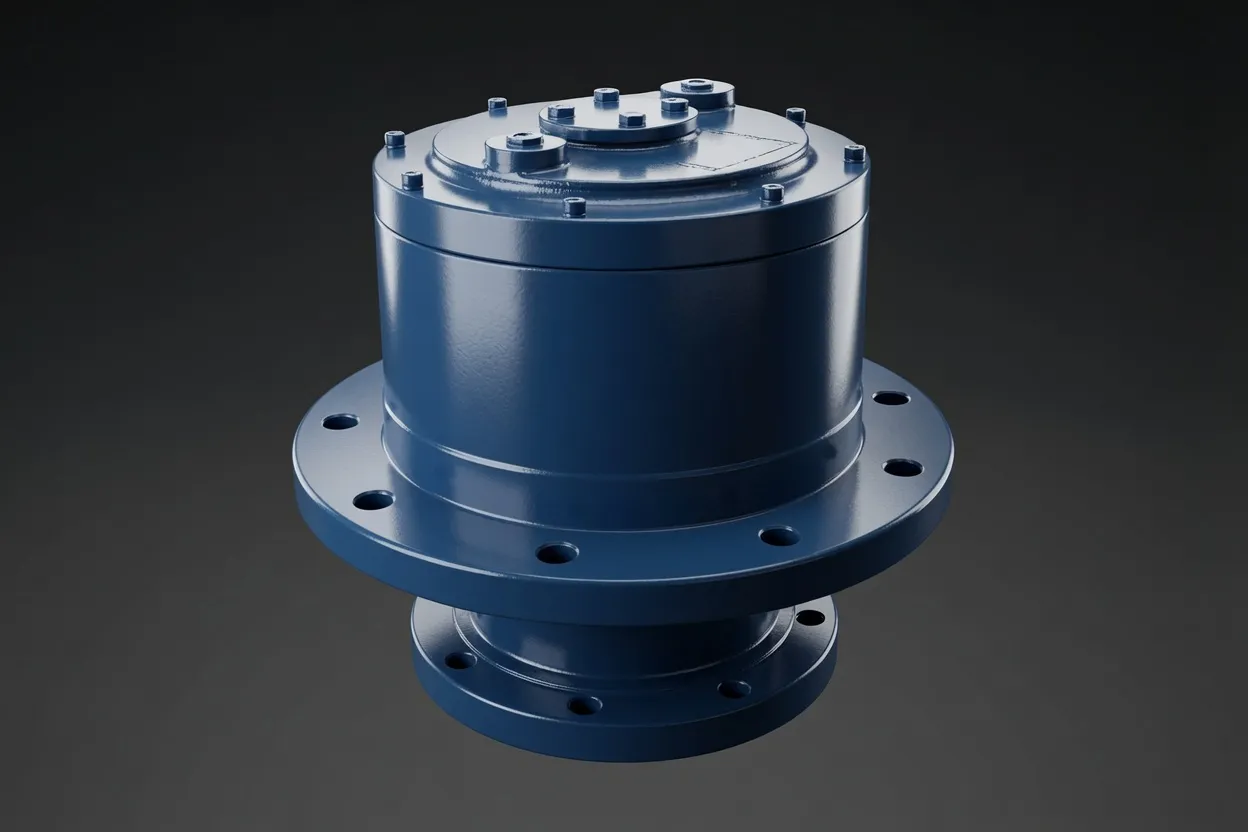
Triplex mud pumps circulate drilling fluid at pressures up to 350 bar and flow rates up to 3,000 liters per minute. An electric motor drives the pump through a planetary gear reducer that matches the motor speed to the pump’s operating range (50–150 RPM). The gearbox absorbs the pulsating torque load characteristic of positive-displacement pumps — three torque peaks per revolution, each corresponding to a piston stroke. This cyclic loading drives fatigue considerations in gear and bearing design, requiring service factors of 1.5 to 2.0 applied to the pump’s mean torque to account for the pulsation amplitude.
Rotary Table Drives
On rigs that use a rotary table instead of a top drive, a planetary gearbox converts motor output to the low speed and high torque needed to rotate the drill string through the Kelly bushing. Ratios of 8:1 to 20:1 deliver output torques of 20,000 to 50,000 Nm at 50–300 RPM. The rotary table gearbox must handle the make-up and break-out torques applied to drill pipe connections, which are intentional overloads reaching 150–200% of the normal drilling torque. Gearboxes for rotary table duty are sized with service factors that explicitly include these connection torques in the fatigue calculation.
Design Features Common to Drilling Rig Gearboxes
⚙️ API and DNV Compliance
Drilling rig gearboxes are designed and documented in compliance with API Spec 7K (drilling equipment), API Spec 8C (hoisting equipment), or DNV-OS-E101 (offshore drilling systems), depending on the application and regulatory jurisdiction. Compliance documentation includes design calculations, material certifications, NDE reports, and factory test records.
High-Temperature Lubricants
Rig-floor ambient temperatures can reach 50 °C in tropical locations, and gearbox internal temperatures add 30–40 °C above ambient during sustained operation. PAO or PAG synthetic gear oils with ISO VG 220–460 provide the film strength and oxidation resistance needed at these elevated temperatures.
️ ATEX/IEC Ex Considerations
Gearboxes installed in Zone 2 or Class I Division 2 hazardous areas must use materials and surface treatments that prevent spark generation from internal friction, static discharge, or external impact. Aluminum housings, non-ferrous wear plates, and controlled surface temperatures address these requirements.
Redundancy in Critical Systems
Top drives and drawworks on offshore rigs often incorporate redundant motor-gearbox drive trains so that a single gearbox failure does not halt drilling operations. Each gearbox is independently capable of handling the full drilling load at reduced speed, providing operational continuity until the failed unit can be replaced during a scheduled maintenance window.
Installation and Commissioning on the Rig
Alignment to Driven Equipment
Align the gearbox to the driven machine (top drive quill, drawworks drum, mud pump crank) using laser alignment tools. Drilling rig structures are subject to thermal expansion and operational deflection that challenge static alignment — verify alignment under both cold and warm conditions and set to the midpoint of the expected range.
Oil System Commissioning
Fill the gearbox and connect the forced-circulation oil system, including the oil cooler, filter, and condition-monitoring sensors. Circulate oil at full flow for 30 minutes before starting the driven equipment to verify pump operation, cooler effectiveness, and filter differential pressure.
Functional Load Test
Run each drive through its full operating envelope — minimum to maximum speed, no-load to rated torque — and verify that motor current, gearbox oil temperature, and vibration levels fall within the acceptance criteria specified in the rig’s commissioning procedure. Document all readings as the baseline for future condition monitoring.
Safety System Integration
Verify the integration between the gearbox’s protection devices (temperature switches, oil level switches, vibration relays) and the rig’s drilling control system. Each protection device should trigger the correct alarm or automatic shutdown response when its threshold is exceeded.
Planetary Gearbox Maintenance on Drilling Rigs
Drilling rig gearboxes operate in remote, often offshore environments where maintenance logistics are challenging and equipment downtime halts revenue-generating operations. A structured condition-monitoring program — combining online vibration and temperature monitoring with monthly oil analysis — provides the lead time needed to plan maintenance activities during scheduled rig moves or well-testing intervals rather than emergency shutdowns. Most drilling contractors target a gearbox inspection interval of 5,000 operating hours, with full overhaul at 15,000 to 20,000 hours depending on the application severity and condition-monitoring data.
Offshore drilling rigs present additional logistics challenges: replacement gearboxes must be transported by supply vessel or helicopter, and workshop space on the rig is limited. Maintaining a critical-spare inventory at the shore base — including one exchange gearbox for each primary drive system — ensures that a failed unit can be replaced within the supply vessel cycle time, typically 24 to 48 hours. The removed unit ships ashore for workshop rebuild, re-entering the spare pool after testing. This exchange approach minimizes rig non-productive time, which can cost $500,000 to $1,000,000 per day on a deepwater drilling rig.
Why Choose Ever-Power for Drilling Rig Planetary Gearboxes
API-Documented Manufacturing
Our drilling rig gearboxes are manufactured with full API-compliant documentation: material test reports, NDE certificates, dimensional inspection records, and factory load-test data. This documentation package supports your rig’s regulatory certification and classification society approval.
Full-Load Factory Testing
Every drilling gearbox runs at rated torque and speed on our test stand for a minimum of 4 hours, with continuous monitoring of oil temperature, vibration, and seal integrity. The test certificate ships with the unit, providing your commissioning team with verified performance data.
️
Offshore Logistics Experience
We supply gearboxes to offshore drilling contractors in the North Sea, Gulf of Mexico, West Africa, and Southeast Asia, with experience managing the special packaging, documentation, and transport requirements for offshore platform delivery.
Critical-Spare Programs
We maintain factory-tested spare gearboxes in our warehouse, reserved for drilling customers’ emergency needs. Annual spare-management agreements guarantee availability and priority dispatch. Contact [email protected] to establish a critical-spare program for your rig fleet.
Frequently Asked Questions
Drill with Confidence — Reliable Gearboxes for Every Rig System
Share your rig type, drive specifications, and operational theater — our drilling equipment team will deliver a comprehensive gearbox proposal.