
In-Wheel Electric Drive · Hub Motor Gear Technology
Electric wheel hub drives integrate the motor, planetary reducer, and brake assembly directly inside the wheel envelope, eliminating the conventional driveshaft, differential, and CV joints. This radical simplification frees chassis space, enables independent torque control at each wheel, and opens new possibilities for vehicle architecture. The planetary gearbox within the hub must deliver high torque density, operate silently, and survive the harsh unsprung-mass environment of shock, vibration, and temperature extremes present at the wheel.
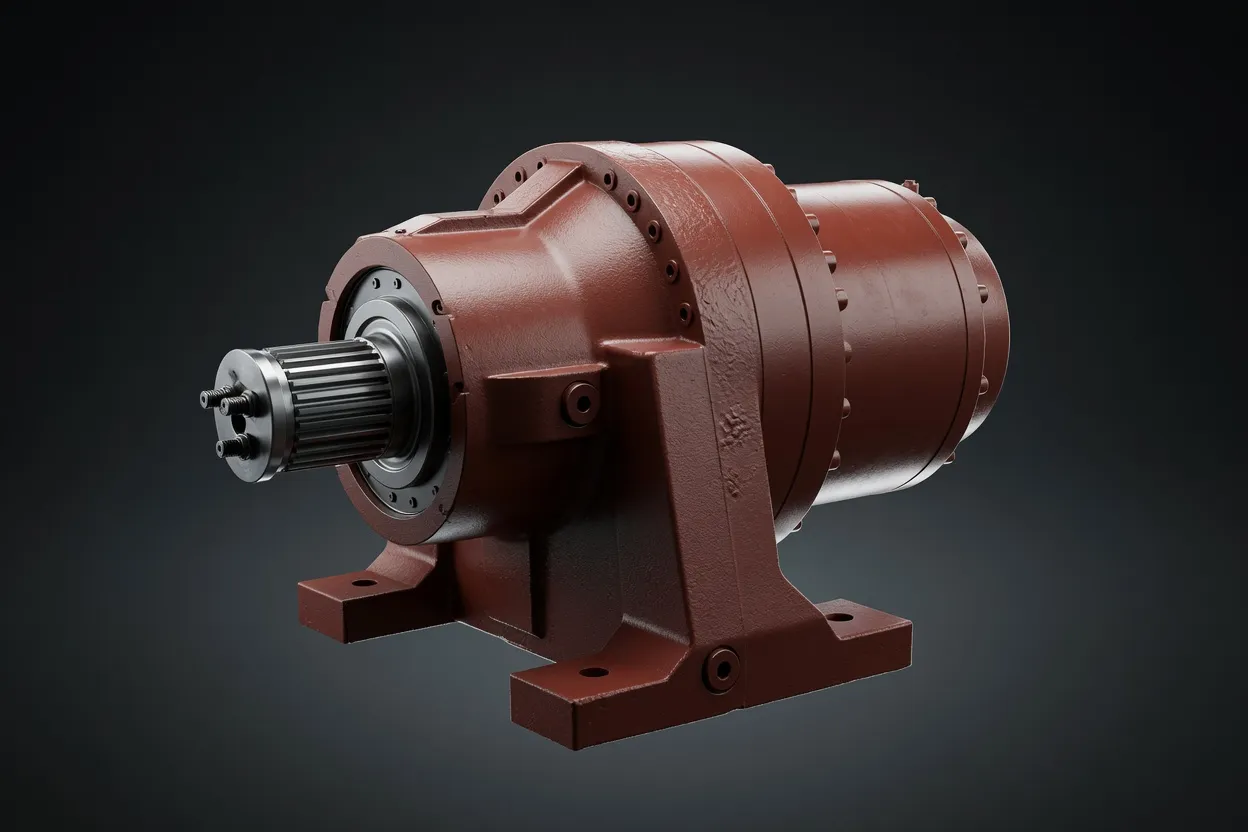
Architecture of a Planetary-Geared Wheel Hub Drive
A geared hub drive places a compact electric motor at the wheel center, coupled to a single-stage or two-stage planetary gear reducer that multiplies motor torque before transmitting it to the wheel rim through a flanged output connection. The motor spins at 5,000 to 15,000 RPM, and the reducer steps this down to the 500–1,500 RPM range that matches typical wheel speeds. Gear ratios of 6:1 to 15:1 cover most passenger car and light commercial vehicle applications, with the specific ratio chosen to balance motor size, torque requirement, and maximum vehicle speed.
Compared to direct-drive (gearless) hub motors, the geared approach allows the use of a smaller, lighter, higher-speed motor — reducing the unsprung mass penalty that has historically limited hub-drive adoption. The planetary gearbox adds some mass and a small efficiency loss (typically 2–4%), but the motor weight savings more than compensate, resulting in a net reduction of 30–50% in total hub-drive assembly weight compared to an equivalent direct-drive unit. This weight advantage improves ride quality, tire grip, and steering response — the very attributes that unsprung mass degrades.
Engineering Challenges Unique to In-Wheel Installations
Unsprung Mass and Ride Dynamics
Every component inside the wheel is unsprung mass — mass not supported by the vehicle’s suspension springs. Excessive unsprung mass reduces the suspension’s ability to maintain tire contact with the road over bumps, degrading grip, comfort, and handling. The high torque planetary gearbox in a hub drive must therefore be as light as possible. Aluminum housings, hollow planet pins, thin-wall ring gears, and optimized gear tooth profiles that maintain strength at minimum weight are essential design strategies. Target total hub-drive mass (motor plus gearbox plus brake) below 25 kg per wheel for passenger car applications.
Shock and Vibration Environment
Hub-mounted components experience road-surface impacts directly, without the attenuation provided by suspension bushings and chassis flexibility. Shock loads from potholes and curb strikes can reach 10 g or higher at the wheel hub. The planetary gearbox must survive these impacts without gear-tooth chipping, bearing brinelling, or housing crack initiation. Specify gears with case-carburized and shot-peened tooth roots, bearings with high static load ratings, and housings with FEA-validated stress distributions under worst-case impact loading scenarios.
Sealing and Environmental Protection
The wheel environment exposes the gearbox to water spray, road salt, mud, gravel impacts, and temperature swings from –40 °C winter operation to +60 °C summer brake-heat soak. IP67 sealing is the minimum requirement — the gearbox must remain leak-free and contaminant-free after submersion in 1 meter of water for 30 minutes, a condition that occurs routinely when driving through puddles or fording shallow water crossings. Multi-lip seals with corrosion-resistant spring elements, O-ring-sealed housing joints, and sealed-for-life bearings address these environmental demands.
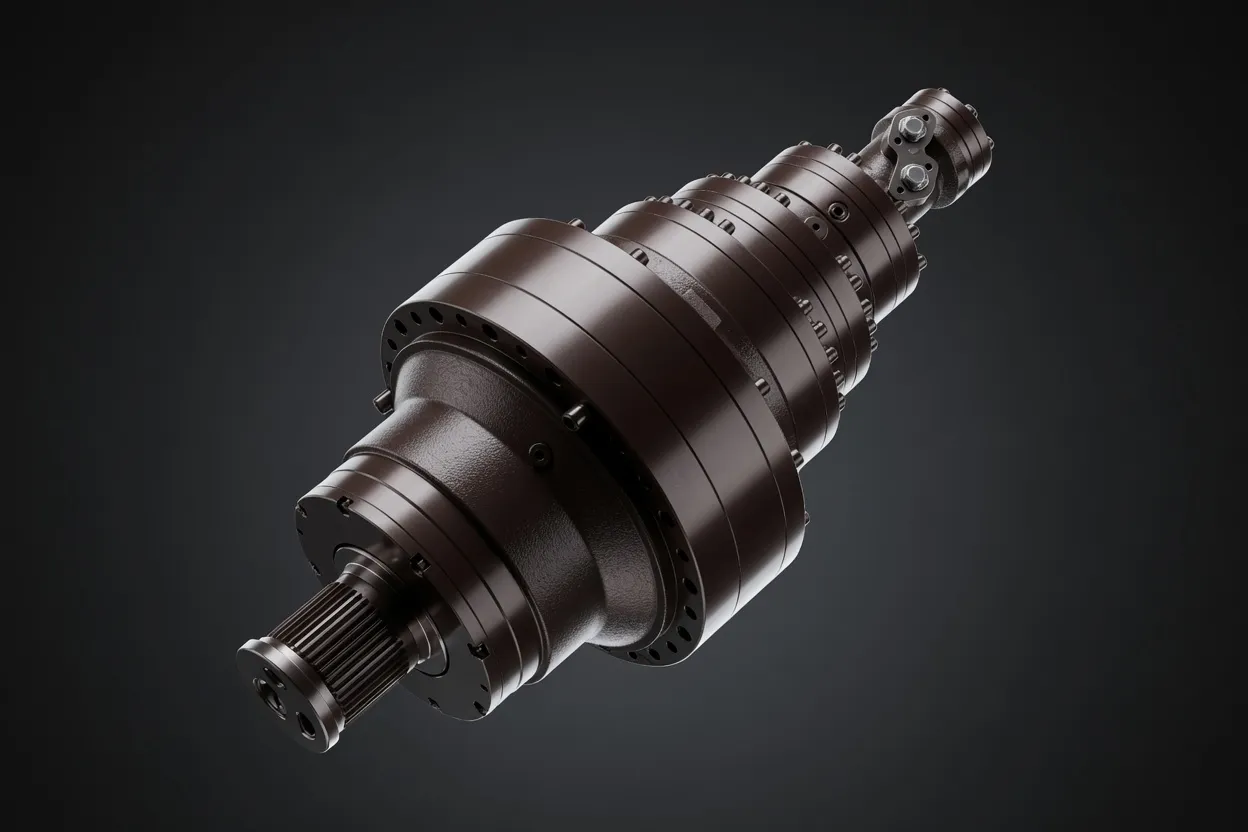
Gear Design for Hub Drive Performance
⚙️ Helical Gearing for NVH
Hub drives lack the chassis structure that attenuates gear noise in centrally mounted drivetrains. Helical planetary gears with overlap ratios above 1.5 reduce mesh excitation, and precision grinding to AGMA Class 11+ ensures that tooth-spacing errors do not introduce additional noise sources. Target gear noise below 65 dB(A) at the wheel hub to prevent occupant perception in the cabin.
High Contact Ratio
Increasing the transverse contact ratio to 1.8 or above ensures that at least two tooth pairs share the load at all times, reducing peak tooth stress and smoothing torque transmission. Combined with the helical overlap ratio, total contact ratio values above 3.0 minimize both noise and stress concentration.
Thin-Section Ring Gear
Packaging within the wheel rim constrains the ring gear’s outer diameter. Thin-section ring gears with optimized root fillet geometry maintain bending strength at reduced material cross-section. FEA-guided stress analysis validates that the reduced section meets fatigue requirements under the combined bending and contact loads expected over the vehicle’s 250,000 km design life.
️ Low-Viscosity Lubricant
Hub-drive gearboxes use low-viscosity synthetic oil (typically ISO VG 22–46) to minimize churning losses at the motor’s high input speed. The lubricant must maintain adequate film strength at the elevated temperatures generated during sustained hill climbing or aggressive driving, requiring synthetic base stocks with high viscosity index and robust EP additive packages.
Thermal Management Inside the Wheel
Heat management is particularly challenging in hub drives because the gearbox shares a confined space with both the electric motor (a major heat source) and the friction brake (an intermittent but intense heat source). During sustained braking from highway speed, brake rotor temperatures can exceed 400 °C, conducting significant heat through the hub structure into the gearbox housing. Thermal barriers — ceramic coatings, air gaps, or low-conductivity mounting interfaces — between the brake and gearbox assembly limit heat transfer to the gear train.
On the motor side, continuous full-torque operation (highway grades, heavy payloads) raises motor winding temperatures to 150 °C or higher, and this heat conducts through the motor housing into the gearbox. Oil circulation through the gearbox — either gravity-fed from the motor’s cooling circuit or pump-assisted — carries this heat to an external cooler. Thermal modeling must simulate worst-case combined scenarios (sustained uphill drive followed by emergency braking) to verify that the lubricant temperature does not exceed its rated limit at any point in the system during these transient events.
Integration with Vehicle Suspension and Braking
The hub-drive gearbox output flange serves as the wheel-mounting interface, transferring drive torque, braking torque, and all road-load forces (vertical, lateral, and longitudinal) between the wheel and the suspension upright. This flange must be engineered for fatigue strength under combined multi-axis loading — a requirement that exceeds the pure-torque design basis of a standard industrial planetary reducer. Co-design between the gearbox housing and the suspension upright eliminates redundant material at the interface, reducing weight while maintaining structural integrity.
Regenerative braking returns a portion of the vehicle’s kinetic energy to the battery through the motor-gearbox chain operating in reverse. The gearbox must handle regenerative torque loads — which can be 60–80% of peak drive torque — with the same efficiency and durability as motoring loads. Bidirectional gear-tooth design and symmetric bearing loading ensure that regenerative operation does not introduce accelerated wear on tooth flanks or bearing surfaces that were not loaded during forward drive.
Why Choose Ever-Power for Hub Drive Planetary Gearboxes
Lightweight Design Expertise
Our engineering team optimizes every component for minimum mass — aluminum housings, hollow planet shafts, and FEA-validated thin-section ring gears — delivering hub-drive reducers that meet passenger-car unsprung-mass targets without compromising torque capacity or durability.
IP67 Sealing Validation
Every hub-drive gearbox undergoes pressure-decay and water-immersion testing to verify IP67 compliance before shipment. Sealing integrity is critical for the harsh wheel-end environment, and we test under conditions that replicate real-world water-fording and salt-spray exposure.
️
Co-Development with OEMs
We engage at the concept stage to co-design the gearbox housing, output flange, and suspension interface as an integrated structure, eliminating mass redundancy and optimizing load paths for the specific vehicle platform.
Prototype and Volume Supply
Development-stage prototypes ship within 20 business days. Production tooling for annual volumes of 10,000+ units is committed within 8 weeks of design freeze. Contact [email protected] to begin your hub-drive gearbox program.
Frequently Asked Questions
Pioneer the Next Generation of In-Wheel Drives
Share your vehicle platform, motor specifications, and packaging constraints — our hub-drive team will deliver an optimized gearbox concept.