
Aerospace · Aircraft Actuator & Landing Gear Drives
Aircraft flight-control actuators, landing-gear retraction mechanisms, cargo-door drives, and thrust-reverser systems depend on lightweight, high-reliability planetary gearboxes that perform flawlessly across the extreme temperature, vibration, and altitude conditions of aerospace service. This guide covers planetary gearbox engineering for aircraft actuator and landing-gear applications, where failure is not an option.
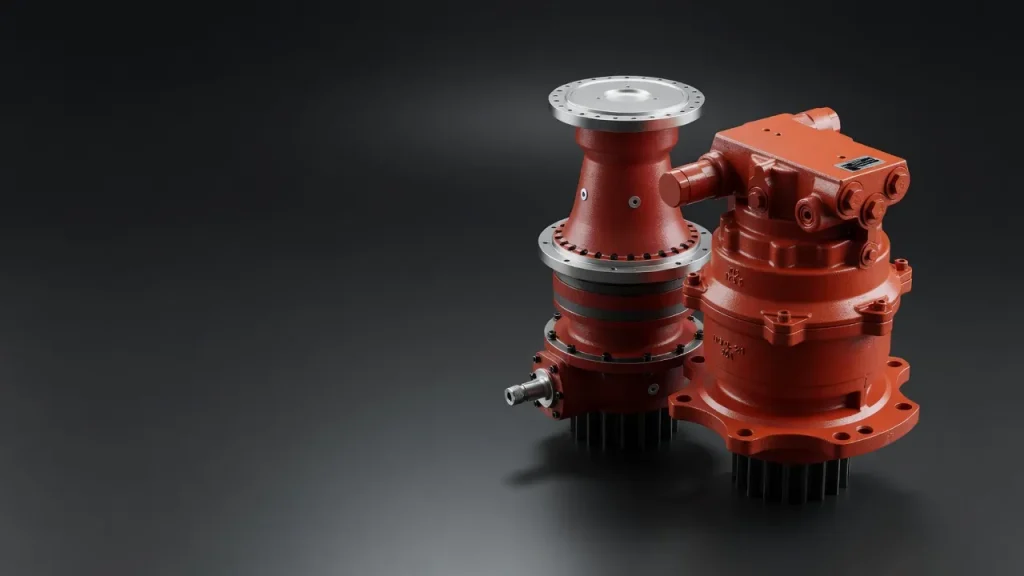
Planetary Gearboxes in Aircraft Actuator Systems
Aircraft use electromechanical actuators (EMAs) and electro-hydrostatic actuators (EHAs) to move flight-control surfaces, landing gear, flaps, slats, and cargo doors. A precision planetary gearbox between the electric motor and the actuator’s ball-screw or rotary output provides the torque multiplication needed to drive these mechanisms against aerodynamic, gravitational, and inertial loads. Ratios of 5:1 to 100:1 cover the range from fast-acting flight-control actuators to slow, high-force landing-gear retraction systems. Every gearbox must meet DO-160 environmental qualification and the aircraft’s design assurance level (DAL) per DO-178/DO-254.
Weight is the dominant design constraint in aerospace gearboxes — every gram saved reduces fuel consumption over the aircraft’s 20- to 30-year operational life. Titanium alloy gears, aluminum-lithium housings, and thin-section bearings minimize mass while maintaining the torque capacity and fatigue life required for flight-safety-critical actuation. A planetary gear reducer for a narrow-body aircraft flap actuator typically weighs 1 to 3 kg complete — delivering torques of 50 to 200 Nm in a package that weighs less than a comparable industrial unit of one-fifth the torque capacity.
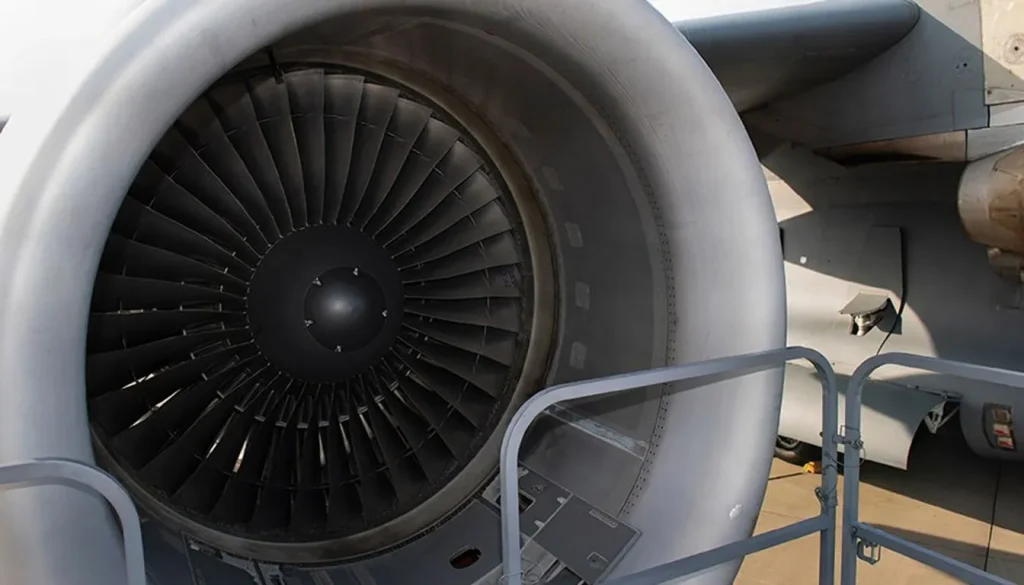
Design Requirements for Aerospace Gearboxes
Lightweight Materials and Construction
Aerospace planetary gears use titanium alloy (Ti-6Al-4V), nitriding steel (Nitralloy 135M), or carburized aerospace steel (9310) depending on the load severity. Housings are machined from 7075-T6 aluminum or fabricated from titanium sheet. Every gram is scrutinized — FEA-driven topology optimization removes non-structural material from housings and carriers while maintaining stiffness targets. The resulting designs achieve torque-to-weight ratios 3 to 5 times higher than industrial equivalents.
Environmental Qualification
Aircraft gearboxes must function from –55 °C at high altitude to +85 °C in engine-bay installations, survive altitude pressure cycling from sea level to 45,000 ft, withstand vibration spectra per DO-160 Category S, and resist contamination from hydraulic fluids, de-icing agents, and jet fuel. Lubricants meeting MIL-PRF-23827 or equivalent specifications maintain film strength across this extreme operating envelope without requiring supplemental heating or cooling.
Reliability and Redundancy
Flight-safety-critical actuators require gearbox reliability exceeding 99.999% per flight hour — corresponding to a failure rate below 10⁻⁵ per hour. Achieving this demands extensive material screening (100% ultrasonic inspection of gear blanks), controlled manufacturing processes (statistical process control on every critical dimension), and system-level redundancy (dual-motor-dual-gearbox architectures on primary flight controls). The low backlash planetary gearbox must maintain its precision specification through 60,000 flight hours — the typical time-between-overhaul interval for aircraft actuation components.
Key Specifications
⚡ Weight Optimization
Torque-to-weight ratios of 30–60 Nm/kg for flight-control actuator gearboxes, achieved through titanium gears, aluminum housings, and FEA-optimized structural design.
Backlash Control
Below 3 arcminutes for flight-control actuators where dead-zone response affects handling qualities. Below 6 arcminutes for landing gear and utility actuators where positioning accuracy is less critical.
️ Temperature Range
Full performance from –55 °C to +85 °C continuous. Short-term survival to +200 °C for engine-bay-mounted actuators. MIL-spec lubricants maintain film strength across the entire range.
️ Qualification Standards
DO-160 environmental qualification, AS9100 manufacturing quality management, and full material traceability to aerospace-grade mill certifications meeting AMS specifications.
Integration and Testing
Motor-Gearbox Assembly
Assemble the motor-gearbox-actuator as a sealed, tested line-replaceable unit (LRU). All internal interfaces are factory-set and verified — field adjustment is not required or permitted on flight-safety-critical actuation systems.
Environmental Testing
Subject the complete actuator to the DO-160 environmental test sequence: temperature cycling, altitude, vibration, humidity, salt fog, and fluid susceptibility. All functional parameters must remain within specification throughout and after the test sequence.
Endurance Testing
Run the actuator through a representative flight-profile duty cycle for the equivalent of 60,000 flight hours (typically 18,000 to 25,000 test hours at accelerated cycling rates). Monitor gearbox backlash, efficiency, and vibration at intervals to generate degradation data that supports the actuator’s certification life.
Flight-Test Support
Provide engineering support during the aircraft’s flight-test campaign, including data review of gearbox health-monitoring parameters and rapid-response analysis if any anomaly is detected during flight testing.
Maintenance and Reliability
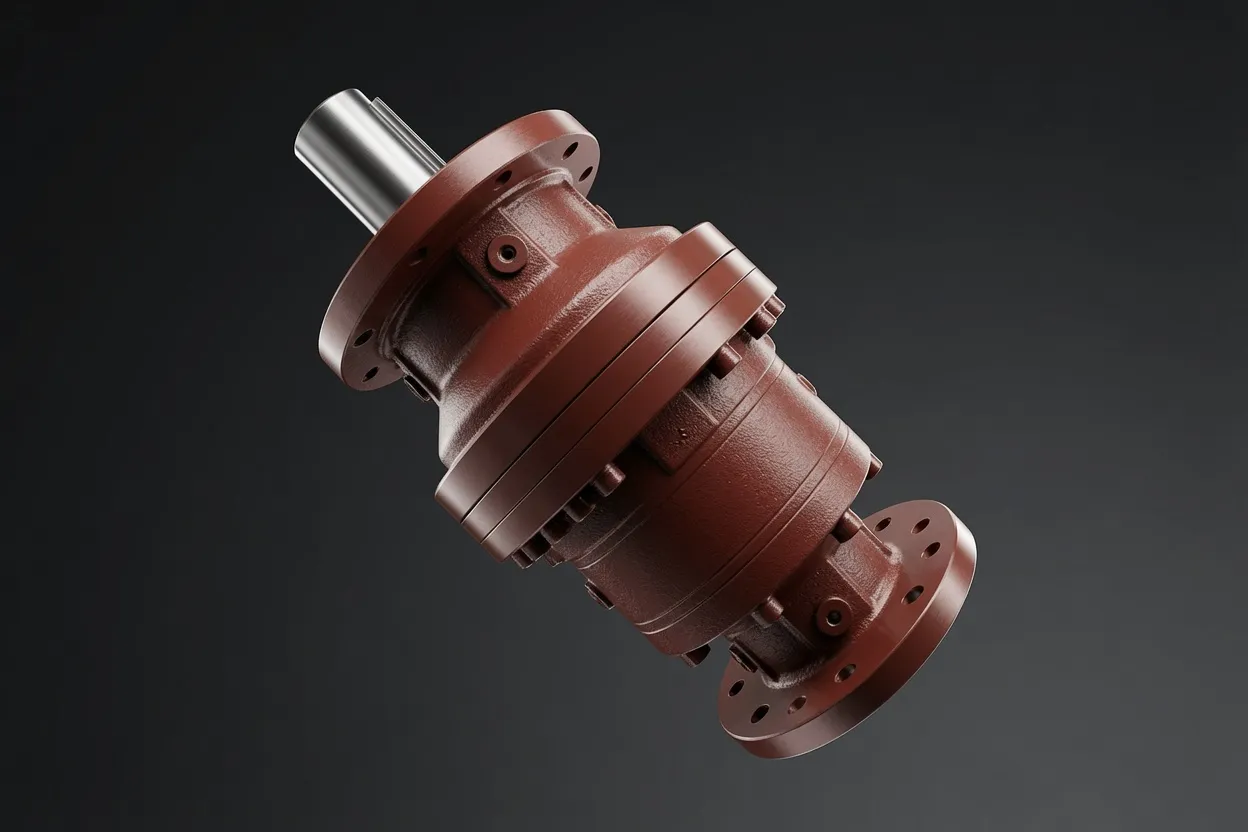
Aerospace gearboxes follow the aircraft’s maintenance program — typically on-condition monitoring supplemented by hard-time overhaul at 30,000 to 60,000 flight hours. Health monitoring parameters include motor current trending (indicating friction change), backlash measurement during scheduled actuator functional checks, and vibration data from the aircraft’s structural health monitoring system. Gearboxes that exceed monitoring thresholds are removed from service and returned to an authorized repair station for overhaul.
The overhaul process includes complete disassembly, 100% non-destructive inspection of all gears and bearings, dimensional verification against the original design data, replacement of all seals and any components exceeding wear limits, reassembly, and full functional and environmental testing. Overhauled units are returned to service with a fresh certification — extending the actuator’s economic life across multiple aircraft overhaul cycles and reducing lifecycle cost compared to full replacement.
Why Choose Ever-Power
Aerospace Manufacturing Standards
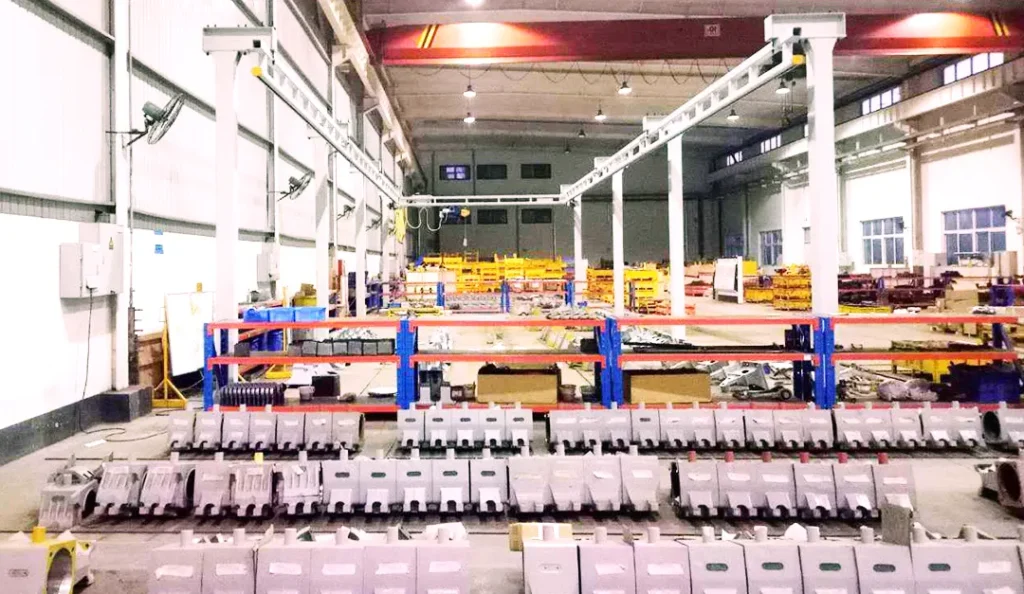
Our aerospace gearbox production operates under AS9100 quality management with NADCAP-accredited special processes (heat treatment, NDT), providing the manufacturing traceability and process control required for flight-hardware production.
DO-160 Test Capability
We perform DO-160 environmental qualification testing in our in-house environmental test laboratory, streamlining the qualification process and reducing the lead time from design freeze to qualified hardware delivery.
️
MRO and Overhaul Services
Our authorized repair station provides overhaul, repair, and return-to-service for aerospace planetary gearboxes, extending actuator life across multiple aircraft maintenance cycles.
Aerospace Program Support
We support aircraft OEM and Tier 1 actuator programs from development through production and aftermarket, with capacity for both prototype quantities and series-production volumes. Contact [email protected].
Frequently Asked Questions
Engineer Your Next Aerospace Actuator with Confidence
Share your actuator specifications, DAL level, and program timeline — our aerospace team will deliver a gearbox proposal with qualification and certification planning.